Monday, October 17, 2016

Worst Election Ever

(Credit: Clinton image from The Huffington Post; Trump image from TheDuran.com, taken from theoddysseyonline.com)
One inspiring thing can be said about the 2016 presidential election as it currently stands: we have the first female major party nominee, and she looks increasingly likely to win. That is a significant thing without a doubt, given that only a century ago, women weren't even guaranteed the right to vote. Indeed, it would be great to see an article, particularly after Hillary Clinton gets elected (should she), that details the work that was done to take us from a country where women couldn't even vote, to one where a woman can get elected president.

But Hillary Clinton's nomination, and even her hypothetical election, are largely symbolic victories, for reasons I've detailed before. And once those symbolic victories are scraped away, we're left with something exceptionally bleak. Perhaps it isn't the worst presidential election in American history--we have had some pretty grim ones, and thankfully neither candidate in this election is openly championing the expansion of slavery, unlike in past elections--but it is the worst in a good while, that much is sure.

Andrew O'Hehir of Salon aptly compared our choice to the 2002 French presidential election, when the final round of voting pitted conservative president Jacques Chirac against ultranationalist anti-Semite xenophobe Jean-Marie Le Pen (whose somewhat less extreme, but far from benevolent, daughter is a major player in French politics today). The difference there was that the French people only had to suffer through two weeks knowing those two were their only options, while we've been stuck with the grim choice between Hillary Clinton and Donald Trump staring us in the face for months. The French also had the good sense to give Le Pen a mere 18% of the final vote, while our own far-right ultranationalist is sure to do far better than that in spite of everything that's happened. And Chirac had the foresight to oppose the Iraq War, which is more than you can say for Clinton, for that matter.

Just like in that election, we had a socialist candidate who should have made it to the final round of voting, but didn't, through flaws in the system--though the flaws in our system are far more intentionally built in than the ones that led to the ugly situation in France. Bernie Sanders was scandal-free, hadn't dirtied his hands by supporting the Iraq War or the PATRIOT Act, and represented a serious vision for progressive change, unlike Clinton. He was also the candidate the people wanted--his favorability was far better than hers, and he did better in head-to-head matchups against the Republicans. But the Democratic Party elites aren't ones to let something like democracy get in the way of what they want. They learned their lesson after George McGovern got the nomination in '72. They pulled every string they could to give Hillary the nomination, going so far that when their misdeeds came to light the DNC chair, soulless lizard Debbie Wasserman Schultz, had to resign in disgrace.

Sanders's campaign marked a high point in this election season, mobilizing young voters in a way that we can only hope continues on now that his candidacy is over. But that's over now, and we're faced with two of the least popular candidates in presidential election history. It's a cruel joke of a choice, given that there's no one to be excited about, and yet apathy could be disastrous give what's at stake. If Clinton is the lousiest the candidate the Democrats have had in maybe decades, Trump is the worst either party's come up with since the end of World War II.

Whatever faithful readers I have may know that I tried to put a more positive spin on the Trump campaign earlier this year, despite always finding him a disgusting human being and never supporting his bid for president. But it's obvious now that Trump is a con man, and I fell for at least some of his con. I thought some part of what he really represented was decent, even an improvement over what we've seen. But Trump stands for nothing aside from a lust for respect and power, and a hatred of anyone who's different than he is.

I have to admit that even after I began to see how truly dangerous and toxic he was, I still found Donald Trump's candidacy funny. I don't mean that I didn't see, and take seriously, the real damage it's done already, but the idea of an orange-skinned, crude, billionaire reality TV host as a serious contender for president was too goddam ridiculous not to laugh at. Trump's candidacy is something like when Abbie Hoffman's Yippies nominated Pigasus the pig for president in the '60s, and not just because in both cases the nominee is a swine.

But whatever humor there was has worn off now. Maybe it's the creepy, awful remarks he made in 2005 that just came out, maybe it was his petulant, infantile performance at the second debate. Trump's absurdity hasn't gone away, but it doesn't inspire laughter, even of the desperate, vaguely horrified kind it used to. It now strikes me as downright offensive that I have to take this idiot, whose candidacy still strikes me as a joke that went too far and has gone sour now, seriously. And it's downright infuriating that millions of people are willingly taking seriously the idea of a useless blowhard like Donald Trump being president.

Anton LaVey once said that "[i]t's too bad stupidity isn't painful." If it were, supporting Trump would be a searing agony, somewhere between pressing a red-hot poker to your flesh and amputating your own foot with a chainsaw. Donald Trump's supporters are misogynists, xenophobes, Islamophobes, racists, Nazis, and Klansmen. And some, I assume, are good people. As hard as I am on political figures, I try to avoid being too vicious to everyday people whose politics I dislike. But supporting Trump at this point is indefensible, if not morally, then just rationally.

Trump is the sort of candidate who shouldn't just lose, but should be ostracized like they used to do in Athens. Best that he be ostracized by the entire human race, sent away from Earth with a one-way ticket some desert wasteland planet that he can name after himself and rule over as king, just to appease his monstrous ego. Comparisons to Hitler are cliched in general and Trump has seen plenty, but they're all too appropriate in his case.

Given the sick monster that the Republicans nominated, I would love it if I could make my peace with the Democrat, as I did four years ago when I enthusiastically supported Obama as a way to keep Romney out of the White House, despite my serious misgivings about his views. But the memory of Clinton's smears on Sanders in the primary are too fresh, and she hasn't made it any easier to support her with her attempts to link Trump and Putin, which are based on little real evidence and harken back to the dark days of Joseph McCarthy warning about his opponents' loyalty to the Soviet Union. The Russia attack is also just a sly of further demonizing Putin, whom Clinton has already ludicrously compared to Hitler. Russia is our Foreign Enemy, and they have no respect for Our Democracy--be afraid. The best thing I can say about Clinton at this point is that she's exercised the minimal competence necessary to keep her ship afloat while the USS Trump has torpedoed itself, which it looks increasingly likely will be enough to win her the election.

In the last debate we got the pleasure of hearing Clinton defend her duplicity by referencing Abraham Lincoln, followed by Trump assuring her that she's no Lincoln. Lincoln's mummified corpse, meanwhile, laid in repose, as dead as the hopes that our next president could represent any salvation from the political hell this country has been condemned to. Yes, that is the worst thing about this election, and the reason I don't take too much solace in the thought that it will be over soon. We will have to live with the decision we make for the next four years. A Trump presidency would be a horrible disaster. Pence would probably make many of the decisions, which is bad enough,
but Trump's desire to silence his opponents and the toxicity of his bigoted statements should not be underestimated. A Clinton presidency looks to be four more years of Obama, minus the good bits--the Iran deal, the thaw in relations with Cuba. Considering how hard it was to get Obamacare passed when the Democrats held sixty seats in the Senate, Clinton's plans for healthcare and student debt, not too bold to begin with, don't have great odds of amounting to anything earth-shattering.

So here we are, then, in a presidential election where both candidates are worse than the current president, which I say as someone who's found plenty to dislike about Obama's policies. This is the first election in a long time that I could confidently say that about, and certainly the first I've lived through. I hope it's the last, but it's hard to know what to expect from American politics at this point. Better luck in four years, I guess. Until then, brace for the worst.

Saturday, September 17, 2016

Dropping the A-bombs: Was It Justified?

The second of this month marked the anniversary of Japan's official surrender; and two days last month, the sixth and ninth, marked the grim anniversaries of the American government's atomic bombings of Hiroshima and Nagasaki, respectively. In the first bombing, "[s]ome 70,000 people probably died as a result of the initial blast, heat, and radiation effects," while in the second, the "best estimate is 40,000 people died initially," according to the US Department of Energy--a source that has some reason to be biased toward being conservative in this respect. Many more, of course, died in both cities from the later effects, and the total casualties including injuries are in the hundreds of thousands without question. The injuries for the survivors, it is worth noting, were at times of the sort where death might have been preferable. What makes these events so significant is not only their sheer horror, but the fact that, to this very day, they find many, many defenders, across the narrow mainstream political spectrum.

Mushroom cloud over Nagasaki (Wikimedia)
Those who celebrate the American decision to annihilate a shocking amount of human life because they see it as just vengeance for Pearl Harbor--a group of which there is a disturbing number--are likely beyond any help, and this blog post is not directed to them. But there are many who think that the bombings were the least awful course of action, as awful as they were--and I used to be among them, not so long ago. While there have been more thorough debunkings of this idea than the one I'll put forward here, I hope this post can be enough to at least plant the seeds of doubt in the minds of any defenders of the bombings who may read this.

Conventional wisdom is that the only options to defeat Japan were the atomic bombings or a full-scale invasion that would have only killed more people than the bombings did; the evidence for this idea, though, is extremely lacking. The US had insisted on "unconditional surrender," refusing to state that the Emperor of Japan could be allowed to keep the throne--even though, ultimately, he was allowed to do so. Secretary of War Henry Stimson would write that "on this question [I] later believe[d] that history might find that the United States, by delay in stating its position, had prolonged the war," and that "a large element of the Japanese Cabinet was ready in the spring [of 1945] to accept substantially the same terms as those finally agreed on[.]" Winston Churchill, too, would later write about how Stalin had received a message that "Japan could not accept 'unconditional surrender,' but might be prepared to compromise on other terms" and that "I dwelt upon the tremendous cost...if we enforced 'unconditional surrender' upon the Japanese."

Japan had been badly devastated already, and for this reason even the highest generals in the US military saw an atomic bombing as unnecessary. The man who would ultimately oversee Japan's reconstruction, Douglas MacArthur--not known for being one to shy away from war and the ugliness thereof--was one of the dissenters to the use of the bomb. Journalist Norman Cousins would later report that "[t]he war might have ended weeks earlier, [MacArthur] said, if the United States had agreed, as it later did anyway, to the retention of the institution of the emperor." MacArthur also stated that his staff "was unanimous in believing Japan was on the point of collapse and surrender."

Perhaps the single most important military figure in World War II, Dwight Eisenhower, would also later say he had had reservations about the use of the bombs. He would write in his memoirs that "I was one of those who felt that there were a number of cogent reasons to question the wisdom of such an act...first on the basis of my belief that Japan was already defeated and that dropping the bomb was completely unnecessary, and secondly because I thought that our country should avoid shocking world opinion by the use of a weapon whose employment was, I thought, no longer mandatory as a measure to save American lives." The fact that it is not just leftist historians but also the great military men of the day and age who actively questioned the use of the atomic bombs should seriously challenge the assumption that the bombings were justified.

So it was against this backdrop, with a war continuing against a devastated country because of a dubious insistence on "unconditional surrender," that on August 6, 1945, the United States dropped the first atomic bomb, "Little Boy," on Hiroshima. The city had been selected partly on the basis that it was "a large urban area of more than three miles in diameter," and that "a large part of the city could be extensively damaged." Perhaps this was considered to be important for the purposes of "obtaining the greatest psychological effect against Japan;" the destruction of a large city--meaning, consequently, the deaths of many civilians therein--being supposedly necessary to have a strong psychological effect on the Japanese.

According to the myth of the atomic bombings that has been propagated in the years since, the Japanese refused to surrender after this first bombing, and it was only after it was clear that no surrender would be issued that the second bomb was dropped. Not so. The decision to drop the second bomb was made on August 7--the day after the first one was dropped. The next day, the Soviet Union announced its declaration of war against Japan--a serious blow to the country, as the foreign minister had hoped the USSR would serve as a mediating force in negotiating the end of the war.

Before the news of the Soviet declaration of war reached Japan, however, according to the Foreign Minister at the time, the Emperor said that "measures should be conducted to insure a prompt ending of hostilities." It was early the next day that the news of the Soviet war against Japan, and the invasion of Manchuria, reached Tokyo. After this news, the Japanese Prime Minister told the cabinet that "continuation of the war is totally impossible...we have no choice but to accept the Potsdam terms." By this point, of course, it was the very day of the second bombing. In fact, the news that Nagasaki had been bombed reached the Cabinet before the meeting had ended.

The significance of the Soviet declaration of war and invasion is so great that some historians have argued that it, rather than the atomic bombs, was the major factor in leading to Japan's surrender. Tsuyoshi Hasegawa of University of California, Santa Barbara, wrote that:
what decisively changed the views of the Japanese ruling elite was the Soviet entry into the war. It catapulted the Japanese government into taking immediate action. For the first time, it forced the government squarely to confront the issue of whether it should accept the Potsdam terms. In the tortuous discussions from August 9 through August 14, the peace party, motivated by a profound sense of betrayal, fear of Soviet influence on occupation policy, and above all by a desperate desire to preserve the imperial house, finally staged a conspiracy to impose the “emperor’s sacred decision” and accept the Potsdam terms, believing that under the circumstances surrendering to the United States would best assure the preservation of the imperial house and save the emperor.
Hasegawa argues that it is likely Japan would have surrendered to the United States even if neither of the atomic bombs had ever been dropped, due to the Soviet invasion of Manchuria. Some have gone even further, such as the United States Strategic Bombing Survey (established by the Secretary of War in 1944), which concluded that "certainly prior to 31 December 1945, and in all probability prior to 1 November 1945, Japan would have surrendered even if the atomic bombs had not been dropped, even if Russia had not entered the war, and even if no invasion had been planned or contemplated."

In any case, it is abundantly clear that there was no attempt to give Japan an appropriate amount of time to consider surrender; rather, it was assumed that more bombings than one would be necessary. In fact, more bombings were planned, but scrapped after the Japanese surrender. Not incomprehensibly, the apparent eagerness to use the atomic bombs even before it was clear they were necessary has led historians like Peter Kuznick of American University and Mark Selden from Cornell to conclude the motivation had more to do with intimidating the Soviet Union and starting the Cold War than winning the war against Japan.

There is also, in addition to the questions of necessity and morality, the question of legality. While many of the treaties that comprise international law today were not in effect at the time of the bombings, some important ones were, such as the Hague Conventions of 1899 and 1907. The conventions prohibited "poison weapons" and "attack or bombardment, by whatever means, of towns, villages, dwellings, or buildings which are undefended," as well as mandating that "all necessary steps must be taken to spare, as far as possible, buildings dedicated to religion, art, science, or charitable purposes, historic monuments." The atomic bombings arguably run afoul of all of these rules.

In fact, the question of the bombings' legality was brought before the District Court of Tokyo in 1963, in the case Ryuichi Shimoda et al. v. The State. Noting that "Hiroshima and Nagasaki were not cities which were resisting an attempt at occupation by land forces at that time," and "were not in immediate danger of occupation by the enemy," the court concluded that "the aerial bombardment with an atomic bomb of both Hiroshima and Nagasaki was an illegal act of hostilities under international law as it existed at that time, as an indiscriminate bombardment of [undefended] cities." The court further argued that:
it can safely be concluded that besides poisons, poisonous gases and bacteria, the use of means of injuring the enemy which cause injury at least as great as or greater than these prohibited materials is prohibited by international law. It is doubtful whether the atomic bomb with its tremendous destructive power was appropriate from the viewpoint of military effect and was really necessary at that time. It is indeed a fact to be regretted that the atomic bombing of the cities of Hiroshima and Nagasaki took away the lives of tens of thousands of citizens, and that among those who have survived are those whose lives are still imperilled [sic] owing to its radioactive effects even now after eighteen years. In this sense it is not too much to say that the sufferings brought about by the atomic bomb are greater than those caused by poisons and poisonous gases; indeed, the act of dropping this bomb may be regarded as contrary to the fundamental principle of the law of war which prohibits the causing of unnecessary suffering.
Knowing all of this, it becomes clear what the atomic bombings of Hiroshima and Nagasaki truly were: at best, grossly misguided and trigger-happy measures taken to end the war; and at worst, an act motivated by a desire to display military might, and marked by a chilling callousness toward human life. There is one thing, though that, in my belief, it is clear that neither bombing was: defensible.

Further sources:
https://en.wikipedia.org/wiki/Atomic_bombings_of_Hiroshima_and_Nagasaki
https://en.wikipedia.org/wiki/Debate_over_the_atomic_bombings_of_Hiroshima_and_Nagasaki

CORRECTION: Originally this post stated that Ryuichi Shimoda et al. v. The State was decided in 1964; it was decided in 1963.

Sunday, August 14, 2016

Anti-Intellectualism, Friedrich Nietzsche, and Donald Trump

Friedrich Nietzsche (left) and Donald Trump (right)
  (Nietzsche image taken from Wikipedia; Trump photo credit Martin Schoeller, image taken from Time)
The rise of a buffoon like Donald Trump to be not only the Republican nominee for president, but someone who's even within single digits of Hillary Clinton, and could plausibly be our next president, raises serious questions. Maybe the biggest one is why in the hell anyone who isn't deeply mentally disturbed would take the idea of Donald Trump as president seriously for as much as a second. There are a lot of reasons for that--none of them are good ones, but they're certainly reasons. One is that people see Trump as existing outside of the corrupt, parasitic political Establishment that, like a tick, has swollen up as it sucks our blood, while leaving disease behind in its wake. Another is that Trump is a blatant racist and sexist, and supporting racism and sexism makes sense in America if you're a white male and happen to have no moral compass (or can just conveniently rationalize that institutional racism and sexism aren't problems and the people who try to address them are the real racists and sexists). But there's another one gets addressed less often, if at all, and which is also an important issue to note: anti-intellectualism.

I want to make it clear right away that I'm not endorsing the vapid and shallow thesis from the ever-vapid and shallow Jonathan Chait, that Trump's supporters just happen to be very stupid and were therefore easily conned into voting for Trump. Trump could be called a con man, but I think that focusing on the idea of Trump as a con artist misses a big element of his appeal. A big part of Trump's appeal has nothing to do with what people think he believes or intends to do, but simply how he behaves; Trump didn't get to be the Republican nominee because he made people believe he has a real breadth of knowledge and a profound understanding of the issues that affect them, or that his proposals make sense. Rather, he got to be the nominee for the exact opposite reason--that he speaks of all issues in a simplistic fashion that lines up with his base's views that these issues are, in fact, very simple. The people who came to support Trump already supported the sort of politics he espouses, before he had even come along. The problem is not simply that the people who support Donald Trump, and a large segment of the population in the United States, aren't intellectuals, it's that they are actively anti-intellect.

What I mean by this is that these people have come to hate anything that is associated with intellectualism--speaking in complex terms, taking nuanced positions, challenging "common sense," and "traditional values," etc. I'm not saying this to be condescending, I'm saying it because their hatred is clearly demonstrated. That's what talk about Trump speaking like a "normal person" really means; there are plenty of people who, without being members of some intelligentsia or trying to make themselves sound smart, talk in more advanced terms than Donald Trump does. After all, all of the other Republican candidates did. But the fact his sentences are at a third-grade level of complexity is part of why people like him. So is the fact that he doesn't go into nitty-gritty details about how to best address illegal immigration, the trade deficit, ISIS, or any other issues. That is a big part of the reason Trump has maintained such an appeal despite the fact that he is not very believable on anything--he's changed many of his positions, some of them in this campaign; there's indication even his central topic, immigration, is just more of his big talk with nothing backing it up (he even criticized Obama for how many people he's deported). No one cares, because many of Trump's supporters are attracted to Trump himself, not his platform--and anti-intellectualism is a big reason why. H.L. Mencken once remarked:
When a candidate for public office faces the voters he does not face men of sense; he faces a mob of men...whose whole thinking is done in terms of emotion, and whose dominant emotion is dread of what they cannot understand. So confronted, the candidate must either bark with the pack or be lost... All the odds are on the man who is, intrinsically, the most devious and mediocre — the man who can most adeptly disperse the notion that his mind is a virtual vacuum. The Presidency tends, year by year, to go to such men...On some great and glorious day the plain folks of the land will reach their heart's desire at last, and the White House will be adorned by a downright moron. [Emphasis added]
While Mencken's cynicism about democracy may be overblown, this describes the Trump phenomenon to a great extent. People have not gravitated toward Trump because, as Chait thinks, they're gullible fools, they have gravitated toward him because he reflects their own feelings and beliefs.

I should thoroughly emphasize that this is not about economic class. It is easy for denunciations of anti-intellectualism to end up being subtly or not-so-subtly classist, as of course people who are poorer--and generally therefore less educated--often obviously aren't as well-informed about a lot of topics, aren't as eloquent, and don't have tastes as "refined" as the richer and more educated classes. I am not talking about a level of education or knowledge; I am talking about a certain attitude that exists in people of various different economic statuses. After all, they are currently rallying behind Trump--a billionaire. And I don't see Trump as some imposter cleverly manipulating these people in some Frank Underwood-esque ploy to become president. I firmly believe he is really and truly one of them, as are plenty of other people who have graduated college, like Trump.

What breeds this sort of anti-intellectualism, though? The answer comes from an unlikely place: the nineteenth century German philosopher Friedrich Nietzsche, who wrote in great detail about the development of morals in society, determining two fundamental strains of morality, master morality and slave morality. Master morality reflects the values associated in ancient times with the aristocracy: valuing individuality, honesty, integrity, and strength, similar to, say, the ideas of chivalry later on. Slave morality, according to Nietzsche, developed as a reaction, based on ressentiment, of those excluded from the aristocracy, who were weaker than the aristocrats:
The revolt of the slaves in morals begins in the very principle of resentment becoming creative and giving birth to values—a resentment experienced by creatures who, deprived as they are of the proper outlet of action, are forced to find their compensation in an imaginary revenge. While every aristocratic morality springs from a triumphant affirmation of its own demands, the slave morality says "no" from the very outset to what is "outside itself," "different from itself," and "not itself: and this "no" is its creative deed.
Thus the values of the aristocrats become what the slaves are opposed to.

While it is not appealing to favor aristocrats over slaves, as Nietzsche arguably does, the analysis fundamentally stands: we have absolutely seen traits that are different turned into evil traits in the mind of the mob, for instance--as Nietzsche noted--with the antisemitism that viewed the Jews, with their distinct religion, culture, and achievements, as a threat to society, culminating with the Holocaust.

Fundamentally, we have people who are not intellectually inclined, to begin with. In the same schools, in the same classes, it is not hard to find the kids who are excited about learning, who like to read, who are interested in math, or science, or literature, and so forth--the "nerds" and "bookworms," in other words--and to contrast that group with the kids who just aren't that way. The non-nerdy kids aren't necessarily stupid, but they do have different interests. We all know the instances of "nerdy kids" getting bullied; why are they targeted in particular? For one thing, they get more respect from teachers because they do better in school, which creates resentment. For another thing, they are a minority, and they clearly differ from the majority--in a way that threatens them with feelings of inferiority. If someone gets better grades than you and seems to know more than you, it is not surprising that you might feel threatened by them.

We are seeing the same sort of thing in the adult world right now. Not shockingly, the people who achieve the most--not in terms of simply accumulating money, but in terms of prestige, awards, respect, etc.--are intellectually inclined people. People who are more intellectual are also readier to challenge "traditional values," established norms, etc., that the less intellectually inclined cherish as ways to make sense of the world. In good times, in a healthy society, the citizenry might as a whole look to the most intellectually inclined of its members with admiration and appreciation, but we are not in a healthy society. Our society is riddled with real problems, and people want a scapegoat. They have found many--blacks, immigrants, Muslims--and intellectuals. They are sick of people who speak differently than they do, don't abide by the same conventional wisdom, don't share the same interests or hold the same moral values. So naturally they turn to the furthest thing from an intellectual they can find, and that is Donald Trump.

The phenomenon precedes Donald Trump by a great deal, and goes far beyond him. Perhaps the first president in the modern era to openly stoke anti-intellectualism was Ronald Reagan, who, for instance, belittled scientists for saying cars threaten the environment when Mount St. Helens emits, by his estimation, far more sulfur dioxide than all the cars in America (experts, of course, pointed out the absurdity of the statement, but that wasn't the point). Certainly we saw the same thing with George W. Bush, who mockingly accused his 2004 opponent John Kerry of finding "nuance" with the situation in Iraq, drawing out the word in a distinctly French fashion to emphasis Kerry's supposed intellectual elitism. With a past like this, it's not surprising we ended up with Donald Trump.

The problem in America is not that we have people who are simply stupid. The problem is that we have people who actively despise intellect itself, valuing feelings over facts. Donald Trump is one of those people, and his success is the product of a trend. The only viable solution is to get to a point where people are not looking for a scapegoat; we all know that bullies are often motivated to find victims by their own victimhood at home. Not everyone can, or should, devote themselves to intellectual pursuits. But when those who do become scapegoats, troubled waters lie ahead.

Wednesday, July 20, 2016

Ten of Hillary Clinton's Enemies

Back in the first Democratic debate, the candidates were asked which enemy they were most proud of making; Hillary Clinton, now our presumptive nominee, seemed to have trouble answering this question, listing off "the NRA, health insurance companies, drug and companies, and - finally - 'the Iranians.'" While the last answer is creepy enough, given her vilification of an entire country, the list of enemies that Hillary Clinton doesn't want us to know about is even worse. In honor of her status as presumptive nominee for the Democratic Party, I decided to rehash ten causes, groups of people, or general concepts that Hillary Clinton is now, or has in the past, been an enemy to.

Hillary Clinton (taken from Biography.com)
  1. Gay rights. While Clinton has cozied up to the LGBT+ community in recent years, she long stood as a staunch opponent of giving gay marriage the same recognition as its straight counterpart. She supported the Defense of Marriage Act when it was passed and signed by her husband; in 2004, she said it was a "fundamental bedrock principle" that marriage "exists between a man and a woman, going back into the mists of history" and emphasized that its "primary, principle role" was for raising children. Clinton was not ambivalent about gay marriage--she was staunchly opposed to it. When she was asked by Chris Matthews in 2002 if "New York State should recognize gay marriage," she answered with a flat "no." It's certainly true that many people's views on gay marriage have shifted over the past couple decades--but Hillary Clinton used to oppose gay marriage in the same uncertain, moralistic terms that Christian conservatives continue to use today. In fact, she only came out in support of gay marriage in 2013--well after even President Obama
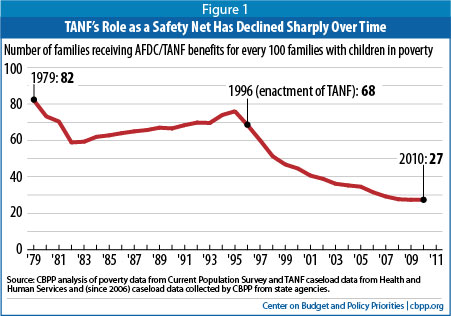
  2. Poor people. Hillary's husband, Bill, signed into law "welfare reform" while he was president, fulfilling his pledge to "end welfare as we know it." This was a law that cut off aid to many legal immigrants, slashed food stamps, and imposed a lifetime limit of five years of welfare benefits, among other things. While, in the short term, poverty decreased--given that the economy was continuing to boom, for the time being--extreme poverty doubled over the next fifteen years. While at the time of the bill's enactment, 68% of families with children in poverty were receiving cash assistance, by 2010, only 27% were. While it was Bill who signed the law, Hillary helped sell it, which she has since boasted about. From this alone, it's clear that Hillary Clinton had a hand in doing major damage to impoverished people in America.
  3. Black people. While, as we've heard numerous times, Hillary Clinton has been the overwhelming favorite of African-American voters in the Democratic primary, it's an objective fact that the policies she's pushed have often been bad for many of them. For instance, the aforementioned welfare reform law naturally hurt a significant number of African-Americans, given that they are disproportionately likely to live in poverty, in a country that still provides enormous advantages to white people over anyone with a darker shade of skin. To make matters worse, the law handed over significant power to the states to restrict who gets welfare benefits resulting in "all of the states with more African-Americans on the welfare rolls [choosing]  tougher rules...large numbers of African-Americans get concentrated in the states with the toughest rules, and large numbers of white recipients get concentrated in the states with the more lenient rules," according to sociologist Joe Soss. Then, of course, there's her pushing of mass incarceration policies--which also disproportionately impact black people--using terms like "super-predator." All things considered, it is very hard to believe that the average African-American is better off because of the policies the Clintons have pushed.
  4. The Right to Privacy. Clinton voted for the Constitution-shredding USA PATRIOT Act, which she has explicitly stated that she doesn't regret. She has defended the surveillance state that emerged as a result, and which has spread its tentacles so far that even the bill's author, Jim Sensenbrenner, has denounced it and attempted to beat it back. In fact, she has made clear she resents the man who allowed Americans to even know about these surveillance programs, Edward Snowden. These programs include phone metadata collection, interception of emails and other online communication, and even a program that collects data on everywhere that you go online. Big Brother is watching you, but Hillary Clinton is there to tell you not to worry about it.
  5.  Corporate regulations. Clinton has a long and consistent history of promoting policies and laws that have made it easier for corporations to do whatever they want. She was a proponent of NAFTA under her husband's administration--a trade deal between the US, Canada, and Mexico that, among other things, allows companies to sue governments for implementing laws that in some way limit their profits (such as environmental laws--TransCanada has used it to sue the US government for refusing to give permission for the Keystone XL Pipeline). Bill Clinton signed into law a repeal of the Glass-Steagall Act (which prohibited commercial banks--the ones where you deposit your money into savings and checking accounts--from investment, after the catastrophic results of speculation in 1929), and Hillary has shot down any suggestion of reinstating the law. She further supported the bank bailouts that gave no-strings-attached money to irresponsible banks that had gotten themselves into financial trouble. Lastly, she vocally supported the TPP--which has been described as NAFTA on steroids--until she started running for president, after which she lied about having supported it. But don't worry, her cronies on the Democratic platform committee made sure nothing in the platform opposes the TPP anyway.
  6. Free Speech. Similar to her lack of regard for the Fourth Amendment, Hillary Clinton has also shown little interest in the first. While she was in the senate, she introduced a law to outlaw flag-burning, punishing it with up to a year in prison. Flag-burning laws have previously been struck down as unconstitutional, but Clinton hoped to get around that by claiming this one was based on "safety." She also co-sponsored the Media Marketing Accountability Act, introduced by Joe Lieberman. Lieberman's bill would have, in his own words, criminalized marketing anything that contains "sex and violence" to minors. This, of course, would include Lieberman's hated enemy, the band Marilyn Manson, whom he well knew had many fans under the age of 18. Lieberman expressed specific concern about "the marketing of obscenity-laced records to kids." The PATRIOT Act, which Clinton staunchly supports (as mentioned above), also prohibits giving counsel to "terrorist groups" as a form of material assistance--this includes advising them on how to nonviolently resolve problems, as the Obama administration successfully defended the government's right to prevent the Humanitarian Law Project from doing just that.
  7. International law. Clinton not only voted for the Iraq War, but spoke out strongly in favor of it, saying there was no doubt Saddam Hussein would "continue to increase his capacity to wage biological and chemical warfare" if left unchecked. The ensuing invasion and occupation of Iraq has been described as the worst war crime of the 21st century by Noam Chomsky, going in complete contradiction of the UN Charter's prohibition of wars of aggression. Clinton also pushed the Obama administration to intervene in Libya, going far beyond the authorization given by the UN Security Council, which had merely called for the enforcement of a no-fly zone. She has also called for a no-fly zone to be implemented in Syria, despite the lack of authority for the US to do so under international law.
  8. The Palestinians. As well as "the Iranians," Clinton might as well have mentioned "the Palestinians" as another one of her enemies. She has loyally supported the Israeli government, defending their worst and most reprehensible actions, and speaking out in favor of right-wing prime minister Benjamin Netanyahu. At one point, she said she sympathized with him when he stated, in effect, that he would not allow the Palestinians to have the state that it is internationally recognized that they are entitled to. Because, again, of her cronies on the platform committee, the Democratic Party platform will not even condemn Israel's illegal West Bank settlements--which even President George W. Bush spoke out against while in office
  9. Environmentalism. While Clinton's environmental record has its bright spots, it also has some pretty big, pretty dark ones. As noted above, she supported both NAFTA and the TPP, which include provisions that effectively allow companies to sue the governments of the countries that are parties to the agreement, if said government implement some sort of environmental legislation or restriction that interferes with the company's ability to make the biggest profit possible. On top of that, Hillary Clinton voted, while in the senate, to open up new areas in the Gulf Coast to offshore drilling (we obviously now know the risks of offshore drilling in the Gulf). On top of that, as Secretary of State she pushed developing countries to allow US companies to engage in hydrofracking in their territory, despite the myriad threats to the environment that fracking entails.
  10. Democracy. From the more mild examples--her collusion with the DNC to ensure her advantage in the Democratic primary--to the more extreme--her description of the Mubaraks, the family of Egypt's then-dictator, as close friends, and her friendliness with the Saudi regime, Hillary Clinton has shown little desire for the spread of democracy, and little concern for the forces that threaten it. Like many politicians, it seems that Clinton's attitude is that despotism is fine as long as it serves her purposes, and the purposes of the US government. If left to her own devices as president, there is little reason to hope she would do much to increase the level of democracy in the US or around the world.
I do not write this to argue against voting for Clinton. As a swing-state resident, if the race looks tight, I will do so. Nor do I blame Bernie Sanders for endorsing her--it was probably the right thing to do, given the circumstances. But, while there is little hope Hillary Clinton could ever really be a good president, there is perhaps some chance that, should the forces that have mobilized behind Bernie Sanders remain active and pressure her to do so, she might push for, and take, some small steps in the right direction on some issues. But in order to understand the task ahead of us, we have to understand what we are up against--and we are up against someone who has been, on many occasions, our enemy.

Wednesday, June 15, 2016

Dear Conservatives: You Were Right

Back before I was a radical leftist, I was basically a mainstream liberal--while I was too young to vote, I identified with the Democratic Party and was a big fan of Obama. Naturally, as a typical liberal, my big enemy, politically, was conservatives, and in an increasingly partisan time, it seemed like liberals and conservatives were constantly locked in a state of war. Every time anyone argued that Republicans or conservatives were being racist or insensitive to racial issues, or sexist, they were accused of playing the "race card," or the "sex card" so naturally I quickly disregarded the idea of the race card and the sex card as conservative propaganda.

Even as I shifted to the left, declaring myself a socialist and distancing myself from Obama and the Democrats, I still focused my ire against conservatives, so naturally I didn't give any more credit to the idea of these cards than I ever had before. Even as I became increasingly left-wing and radical, declaring myself an anarchist for some time, and became increasingly harsh in my criticism of liberals and Democrats--seeing them, too, as my enemies now--I never gave much thought to the idea that maybe the right-wing criticisms of liberals had any merit anywhere. But that's changed now.

So, here it is: I'm sorry, conservatives. You were right about this much: there is a race card, and there is a sex card, and liberals do play them shamelessly. Of course, I'm not going to pretend that every time a liberal has accused a conservative of racism or sexism, it was just them playing the race card. I do think there are major issues in terms of racial and gender inequality in the US, that conservatives--and for that matter, to a lesser extent, liberals--allow to go on, and make worse. But I do see now that at least some liberals are utterly willing to make spurious and absurd accusations of racism and sexism to try to discredit their opponents.

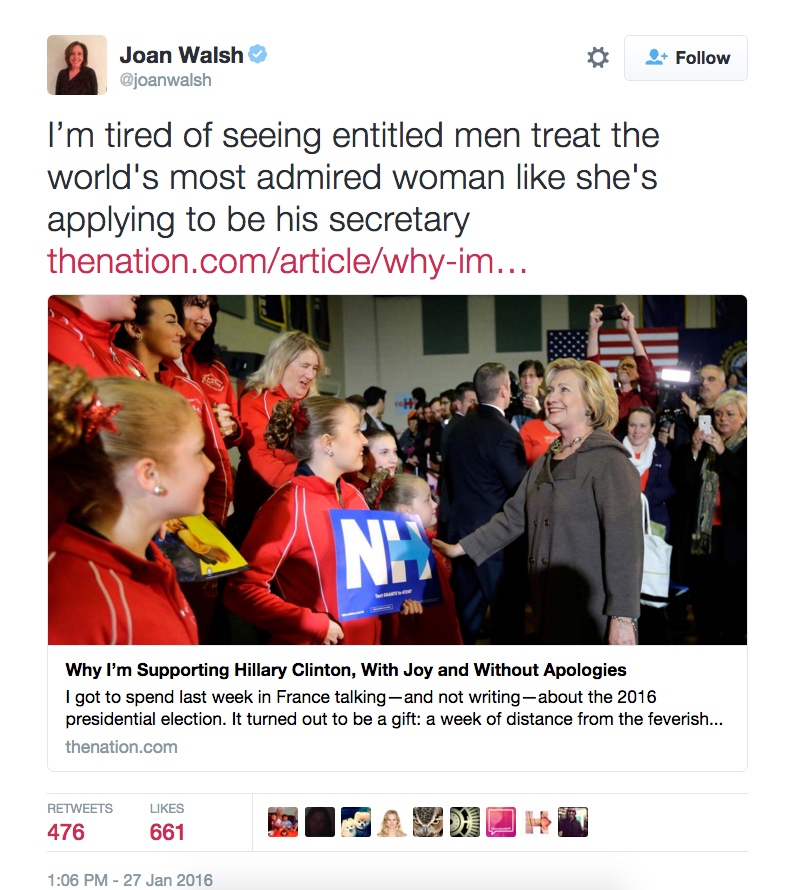
What made me change my mind? Being a Sanders supporter. Clinton has insinuated Sanders is sexist and racist; her sycophantic foot-licker Amanda Marcotte has put out a hundred thousand million articles smearing Sanders and his supporters as a bunch of racist-sexist "Bros." Joan Walsh, another devoted guard dog of the status quo, has stated that she "reject[s] the moral superiority of a coalition led by white men vs. the will of black, brown and female voters" and has tried to paint Sanders supporters as largely sexist more than once. Even I've been accused of misogyny by Clinton supporters.

Amanda Marcotte, self-appointed Clinton
propagandist
  (picture from Twitter)
It's hard to overstate the total shit-headed stupidity of all of this. Even Planned Parenthood, which has stupidly decided that Clinton should be the first presidential candidate it endorses during a primary--ever--has admitted that "Bernie Sanders and Hillary Clinton are both rated 100% on Planned Parenthood Action Fund’s congressional scorecard for their perfect voting records on women’s health and rights." Sanders has also received a 97% score from the NAACP. So trying to attack him as a sexist or racist is extraordinarily dubious.

As for the campaign to paint his supporters as racist or sexist, that ignores that there are plenty of women and minorities who have supported Bernie Sanders--in fact, he's the favored candidate among young women, and has done well among young minority voters as well. Claims that all his supporters are white males are nothing but bile vomited up by the self-appointed Goebbelses of the Clinton campaign, happy to serve as her Ministers of Truth free of charge.

So it's very clear that there are liberals who "play the race/sex card" against leftists--who claim that because their candidate, Clinton, is a woman, and the leftists' candidate, Sanders, is a man, that must mean they, the liberals, are the more supportive of women's rights, and must mean even that the leftists are sexists. The addition of racism accusations on top of that simple-minded garbage acts as the rotten cherry on the top of the shit sundae.

It's hard, then, to believe that there aren't at least some instances of liberals pulling the same slimy tactic against conservatives. I certainly don't think that every conservative is a racist or a sexist, and liberals like Walsh, Marcotte, and Clinton herself have shown themselves to be so willing to make spurious accusations, or at least insinuations, of racism and sexism, that it's impossible to imagine that no one in their same toxic ideological circle has done the same against a conservative.

So, conservatives, I'm sorry. I still hate your ideology, and have issues with many of you as people, but I'm sure some non-racist and non-sexist conservatives have been accused of racism or sexism baselessly. Hell, I even have a friend--no conservative at this point, but perhaps one in the past--who was accused of racism just because he slightly preferred McCain in 2008. So I suppose I should have known better. We may not be able to agree on much at all, conservatives, but this we can agree on: there are too many boys crying wolf among the liberals--slanderers with no souls, no sense of decency, and no qualms about making that fact clear to the world.

Saturday, May 21, 2016

Why You Might Not Actually Like Capitalism

Put aside what you think you know about capitalism for a second--the ideas of competition, of the invisible hand, of supply and demand, of higher pay for more work. Those are not the defining aspects of capitalism, despite what a lot of people might think. Rather, there is one central tenet of capitalism: private ownership of the means of production.

What does that mean? It means that companies are run not by the people doing the work, but by somebody else--whether a slew of investors with varying degrees of ownership, one single person, or whatever. The key thing is, the workers are not the ones who own and manage the company, and the owners collect the profit. That is what separates capitalism from socialism.

"That's not the only thing that separates capitalism from socialism, though," you might be saying now. But no, it actually is--pretty much anything else you can name that people tend to associate with capitalism is compatible with socialism. If you don't believe me, take a moment to learn about market socialism, where enterprises owned by their workers compete in a market system--so there are all the same tenets of supply and demand, the invisible hand, and competition all exist.

(Taken from Wikimedia)
Nor does socialism mean everyone gets paid the same thing or that people are only paid according to their needs; we can debate the merits of those ideas, and certain forms of socialism may embrace them, but other forms of socialism reject them wholeheartedly. Nor does socialism mean the government runs everything; some forms of socialism--anarchist forms--think there should be no government at all. There have been, and are, socialists who advocated all services be provided by worker-owned companies in a market system, with no centralized government.

So if you don't think that having the means of production--that is, companies--be privately owned, with workers essentially renting themselves and receiving less than the fruit of their labor, is the best possible system, you might actually be a socialist and just not have realized it yet. There are certainly other models out there that are working--there are companies where the workers own all or at least part of the company, and they've been working pretty well. Robert Reich recently wrote an article about this trend, but failed to realize that if the workers own the company, it's not actually capitalism anymore.

But maybe having investors or businessman own companies and workers just rent themselves seems okay to you. What's the problem with it? Well, for one thing, it means the workers aren't receiving the full fruits of their labor. With many successful companies, we have investors who have gotten very rich off of them while workers, well, haven't. That's not surprising when you consider that workers are generally paid wages or a salary, meaning they're paid based on either the hours they put in or just on a monthly or yearly basis, neither of which really take into account how hard they're working and how much money they're bringing in. Some workers earn a commission, but even then they only get a relatively small portion of the money they bring in.

But the person or people who own the business own all of the stuff the workers use to do their jobs, right? The building, the machinery, that sort of stuff--and without that, there would be no job, right? Well, sure. But clearly, the business owner is looking to make more money than she or he would just by selling the capital they own; otherwise, they would just sell the capital they own. After all, that would be a lot quicker and more painless than starting a business with it.

So the workers are still kind of getting a raw deal, since they're basically paying for the means of production, but don't actually get to ever own them. We know that as renting, and it kind of sucks, if we're honest with ourselves. While of course renting can be nice in the short-term since it's cheaper than buying, in the long-term it just means you pay, and pay, and pay, without ever owning the thing you're paying for. Which sucks.

"But investors are risking their money. Shouldn't we reward risk?" Well, maybe--we should certainly be willing to reward people who take a risk to achieve something worthwhile. But the idea that people taking a risk by making an investment is valuable is only true when we're in a system that has to rely on private investments, i.e., where companies are privately owned. If the workers owned the companies, they would be taking the risk, and accordingly could reap the reward.

As it currently stands, the reward goes to people who are wise enough, or lucky enough, to risk their money on something that pans out, which is called gambling, and is actually illegal in a lot of places (though obviously investments stand as an exception to anti-gambling laws). The difference between investments and gambling in a card game, though, is that if you win, your reward comes from someone who never actually agreed to take part in the bet--that is, the workers. And, like only the stupidest or most unlucky of gamblers, the workers never win.

The point here is obviously not to demonize anyone who owns a business or owns stock in a company--currently, that's the system we have, so
it's understandable, sometimes only practical, to work within it. The point is to ask whether that system is really the best and most fair we could have--because even if you love the ideas of competition in the marketplace, and higher pay for people who do more work, that doesn't actually mean you support capitalism. Maybe after all of this, though, you do still support capitalism, in which case, okay. But whatever the case may be, we have to actually understand what capitalism is if we're going to ever have an honest discussion about its merits and pitfalls.

Sunday, April 10, 2016

Admitting I May Have Spoken Too Soon

I've published a couple blog posts recently that downplayed how scary Donald Trump is. I still stand by many of the arguments I made, but I think I may have failed to properly acknowledge the danger I now firmly believe that Trump poses. To be clear, I was never arguing that anyone should vote for Trump or support him over Hillary Clinton, but the idea of Trump seemed, well, maybe bearable if it meant that in four years we could get a genuine progressive--not a Clinton--into office. No longer.

(Picture taken from Wikipedia)
For one thing, I think there were some issues I failed to properly account for. For instance, I noted that Trump sounds less hawkish than his fellow Republicans--and even less so than Hillary--when it comes to issues like Assad, Libya, and Iraq. This is true. However, Hussein, Gaddafi, and Assad were all secular nationalist dictators, and Trump's argument against toppling them is that their countries have been (or would be) overrun by jihadis as a result. He's right, but I mistook this as a sign he is dovish, at least compared to the neocons, and perhaps more dovish than Clinton (who's basically a soft-core neocon).

That was a mistake. While Trump may not be eager to topple secular dictators--and rightly not--the reason is because it results in the spread of jihadism, and it doesn't indicate that he would be dovish at all when it comes to jihadists--which is pretty concerning when we're involved in a conflict with ISIS. The answer to how far Trump would be willing to go is hinted at by his refusal to rule out nuking ISIS. Like a lot of the crap that spews forth from Trump's oral cavity--a veritable Old Faithful of crap-spewing--this is probably bluster, but it's dangerous bluster. The idea of the US nuking the Middle East should raise alarms all over the world. And if Trump is willing to keep that option on the table--even for the sake of looking macho--that's good reason to believe he could still be very, very vicious and dangerous in fighting ISIS, at the expense of the people who happen to be living nearby.

Speaking of nukes, there's also his talk of no longer offering protection to South Korea and Japan and encouraging them to develop their own nuclear weapons. This is a genuinely awful idea, and very dangerous even if it's more bluster. If Japan or South Korea believe that the US no longer intends to keep them under its security umbrella, and would be willing to let them develop their own arsenal, either country--particularly South Korea--might just do that. That would be a serious blow to the Non-Proliferation Treaty, resulting in other countries demanding the right to develop their own nuclear weapons--increasing both the risk of nuclear war and the risk of terrorists getting material to create a "dirty bomb" (if not getting their hands on a nuke itself). Those aren't the sort of dangers you laugh off.

Domestically, I think perhaps I underestimated how bad he could be as well. As mentioned, Trump's full of bluster, and I doubt he'd really try to shut down mosques or deport every illegal immigrant. But he's been happy to tap into those fears to gain support, and I see no reason to think he'd stop as president. He'd likely enact some token policies to deal with the Muslim Question and the Illegal Question, but the real concern is the impact a president who's a spokesman for hate and bigotry could be. We've already seen violence from Trump's supporters. Imagine what we might see if the head of the country is there normalizing xenophobia and Islamophobia every day.

So was I wrong to think Trump wouldn't be as bad as Bush? I don't think I was. It would be hard to be as damaging a president as Bush was. But Bush took office before the economy had taken the sucker-punch to the gut that was the Great Recession, before we were already enmeshed in wars in the Middle East, and before 9/11 had happened. The country is in much shakier shape now than it was when Bush took office, and a less damaging president than Bush could still put us into a very, very bad situation.

So, very reluctantly, if it's what it takes to prevent Trump from gaining office, I will vote for Hillary Clinton. Clinton represents everything I hate about modern politics, but Trump is even worse than that. He may sound better than Clinton at times--he may even really be better than Clinton on some important issues--but she isn't willing to throw around the idea of nuking ISIS (or nuking frigging Europe, which is truly insane) or letting other countries develop their own nuclear arsenals and yanking the security blanket we've provided out from under them, as they worry about their neighbors and the real or imagined threat they pose. Nor does she seem eager to exploit xenophobia or Islamophobia to her advantage. So, yes, it's worth supporting her over Trump, even if it would mean we probably wouldn't have a chance of having a progressive president until at least 2025.