Thursday, March 19, 2020

Living in the Future

Sarah Palin appears on The Masked Singer (screenshot via YouTube courtesy of Mic)

My faith's been torn asunder
Tell me is that rolling thunder
Or just the sinking sound
Of something righteous going under

Don't worry, darling
No baby, don't you fret
We're living in the future
And none of this has happened yet
—Bruce Springsteen, "Livin' in the Future"

I had a strange moment as I was driving home last Friday. My thoughts were jumping around the way they usually do on night drives like that one. The main thing on my mind was the COVID-19 pandemic. Much more would come of that outbreak over the next few days, as restaurants and bars were forced to shut down and my state's primary election was ultimately postponed to stem the spread of disease. My thoughts also drifted to another, much stupider recent event: the completely surreal appearance of former governor and vice presidential candidate Sarah Palin on Fox's already-ridiculous show The Masked Singer. Earlier that week, Palin, dressed in a pink bear costume, had spat reworked lyrics to Sir Mix-a-Lot's "Baby Got Back" in an event that no sober person could have imagined back in 2008 when she first came on the national scene. There was no obvious connection between these two things, a deadly global pandemic on the one hand and washed-up politician's last gasp for relevance on the other. But considering them together, as two wildly dissimilar but contemporary news stories, an ominous question emerged: what if this is just how things are gonna be?

Start with the COVID-19 pandemic. In the United States at least, we are not faced only with the disease itself but also with a society that seems almost perfectly designed to let it flourish: a state that has been hollowed out by neoliberalism over the past few decades, and is now presided over by a former reality show host whose reign has been marked by open incompetence and corruption; a private healthcare system that has little incentive to focus on testing and providing proper treatment to those who need it; and a culture where misinformation readily spreads among a populace that has grown rightfully distrustful of its own government and mass media, as well as of "experts" of any sort. And now that the seriousness of the new coronavirus outbreak is starting to be understood, the deep dysfunction and irrationality is beginning to make itself known: supermarket shelves left barren as people start bafflingly stocking up on toilet paper in large quantities, travel bans enacted against China and Europe over the objections of health experts, the stock market thrown into chaos, lives disrupted as universities and places of employment shut down.

COVID-19 is not the first global pandemic, and it certainly won't be the last. As the planet's climate is progressively altered and the permafrost—home to all sorts of dormant bacteria and vira—melts, and as our globalized culture continues to become more and more integrated with people and cargo traveling from all parts of the world with regularity, it's likely there's more where this came from. While some places, like South Korea, have done an admirable job of responding to the coronavirus pandemic, taken as a whole the global response does not portend terribly well for how these future outbreaks will be handled.

Obviously, the greatest tragedy of COVID-19 and any future pandemics will be the many lives lost to them. But it's fair to also ponder the cultural impact semi-regular outbreaks would have on the vast majority of us who survive them. The irony of the term "social distancing," the practice now being encouraged to prevent the spread of disease, is that it could just as easily be applied to what we've all been doing, willfully or not, over the course of the past few decades. As the collective institutions and groupings that, for better or worse, provided some sense of community have disintegrated (in accordance with Margaret Thatcher's proclamation that "there's no such thing as society"), societies have more and more resembled collections of atomized individuals. We've hardly had much choice to but withdraw further and further into ourselves as practically everything—jobs, homes, acquaintances, marriages—became more and more temporary by necessity. The personal relationships and face-to-face interactions that were once central have become increasingly supplanted by social media, which often encourages the meanest, dumbest and most narcissistic impulses, leaving people more alienated and less empathetic than they once were—not, of course, that we should wax too nostalgic about the "good old days," which were full of their own problems and injustices. And now, if every so often, we must worry that face-to-face interaction might help spread life-threatening illnesses—and cope with the inevitable disruptions to day-to-day life the response and reaction to such outbreaks will entail—that will just be one more factor pushing us towards personal isolation.

It's that same atomization that has helped give us bizarre scenes like Sarah Palin rapping on TV—or a former game show host being sworn in as president for that matter. For politics to be participatory or democratic in any profound sense, collective institutions and organizations—not to mention just some general sense of community—are necessary, and all of those are what's been getting power-washed away like an old coat of paint. So when politics based on mass organization and participation becomes obsolete, what happens? Politics must glom onto some other sort of cultural phenomena, effect some kind of merger. That's where the entertainment industry comes in.

Entertainment, after all, is yet another thing that must fill the gaps left behind by the neoliberalization of modern society. The fact that it's become increasingly available over the past few decades is not simply a fortunate coincidence—and, if possible, it will only become more ubiquitous the further social atomization progresses. How else can you keep a populace of increasingly alienated individuals from either rebelling against the system or simply imploding altogether? It's no wonder that politics and entertainment appear to be merging, up to and including a sort of revolving door that now connects the two of them: at the same time the old forms of politics have died off, entertainment dominates the cultural landscape more and more, and it naturally has to evolve to keep its consumers' attention. If religion was the opium of the masses in Marx's age, something must take its place in an increasingly post-religious landscape.

Not that we will ever reach the levels of, say, the societies imagined in Mike Judge's Idiocracy or Aldous Huxley's Brave New World, where every form of mass entertainment is artless vulgarity or overwhelming absurdity. No, far from it: people have to get intellectual stimulation from somewhere. There are, and will always continue to be, many shows, movies and books that are intelligent, well-crafted and of serious artistic value. But that's just it: soon enough, the only place that level of profundity or thoughtfulness might be found is in the realm of entertainment, where it's safely directed away from any use that could end up threatening the status quo and serves as just another temporary distraction from the alienation of modern life. It's something of a cold comfort to know we will always have prestige TV and cinema when they serve only as a break from the chaos and irrationality of everything else.

This is the nightmare future we are faced with—not some radical deviation, but merely the worst and most frightening (as well as the most ridiculous) aspects of the past few years and decades made regular, turned into the new "normal." The feelings of isolation and fear we're experience we're all experiencing right now could become just another part of day-to-day life, while politics is finally reduced to the level of a spectator sport—just one more reality show to waste some time on.

Of course, it's not yet inevitable. While Bernie Sanders now stands little chance of becoming the Democratic nominee, the movement he helped to build with this campaign and his 2016 one is a promising deviation from the long-term trends we've seen in politics and society. And the coronavirus epidemic plus the economic turmoil it's already wreaking could prove enough of a shock that we're forced to confront the ominous direction we're headed in, and find a way to change it. Those glimmers of hope, however small, do not have to disappear regardless of who ends up winning the 2020 election. But the window of opportunity is closing. Let these past weeks and the months ahead be a warning that spurs some sort of action, and not a preview of what the future will be.

Wednesday, March 4, 2020

The Vampires Strike Back

Well, no one said it would be easy. We knew that the Democratic Establishment was in full panic mode after Bernie Sanders scored a trio of victories (at least in the popular vote), in Iowa, New Hampshire and Nevada—the first three states on the primary calendar. Now we're seeing the full extent of their desperation. After Biden managed to score a big victory in South Carolina and became the first candidate to defeat Sanders anywhere, the wagons have circled: Pete Buttigieg and Amy Klobuchar unexpectedly called it quits, along with billionaire donor Tom Steyer, leaving Biden as the only remaining candidate in the "moderate lane" aside from Michael Bloomberg.* Shortly after, they threw their support behind Uncle Joe, and were joined by one Robert "Beto" O'Rourke, who long-time viewers will remember as yesteryear's Hot New Thing in the world of Democratic politics, as well as former Senate Majority Leader Harry Reid. It looks like Mr. Hope and Change himself, former president Obama, may have even played some role in at least Buttigieg's decision. Now, as I'm writing this, it's Super Tuesday, and Biden looks positioned to stage a major comeback.** FiveThirtyEight already gives him a 31% chance of securing a majority of delegates in the primaries, while Sanders has fallen to just 8% after being the favorite for weeks (the most likely possibility, with 61%, is still that no one secures a majority).

Shirts sold by the Biden campaign, celebrating his latest
endorsements (via Team Joe Store)
This comes just after Biden got caught in an astounding lie about getting arrested while trying to visit Nelson Mandela, a new spin on his old fabrication about marching in the Civil Rights movement. Of course, it might be unfair to call it a lie for that matter. Joe's been having his share of innocent slip-ups lately, such as saying that he's running for Senate and that if voters don't like him they can "vote for the other Biden," and apparently forgetting the quote from the Declaration of Independence about all men being created equal—the one every third grader knows—about halfway through his attempt to recite it ("All men and women created by the—you know—you know the thing.") None of that matters when there's a chance the peons might actually storm the Bastille and nominate someone who really means it when they use the old Democratic Party talking points (those ones about creating a fair economy and looking out for working class people).

No—the one thing the Democratic Party power brokers care about is right there in their name. For anyone who suffers from any other illusion, what we're seeing right now should be the equivalent of Winston Smith's shock treatment in 1984:
"You are ruling over us for our own good," he said feebly. "You believe that human beings are not fit to govern themselves, and therefore—"

He started and almost cried out. A pang of pain had shot through his body. O'Brien had pushed the lever of the dial up to thirty-five.
"That was stupid, Winston, stupid!" he said. "You should know better than to say a thing like that."

He pulled the lever back and continued:
"Now I will tell you the answer to my question. It is this. The Party seeks power entirely for its own sake. We are not interested in the good of others; we are interested solely in power. Not wealth or luxury or long life or happiness: only power, pure power...We know that no one ever seizes power with the intention of relinquishing it. Power is not a means, it is an end...The object of power is power. Now do you begin to understand me?"
Of course, poor old Joe is just a pawn in their game, to borrow Bob Dylan's turn of phrase—and in a just world, elder abuse would added to the list of charges against all the insiders and hacks pushing Biden's campaign along. There's a poetry to it all. You couldn't ask for a better embodiment of the decrepit, decadent Democratic Center that's been in power for decades: the wizened old moderate who once gave Strom Thurmond's eulogy and was to the right of Ronald Reagan on criminal justice, and who now struggles to go a week without messing up a news anchor's name or forgetting which president it was that he served under. Who needs Thomas Nast anymore when the politicians are already their own caricatures?

There's, of course, no point in whining about fairness in all of this. All's fair in love and war, and in politics, one might add. The tactics the Establishment is relying on aren't even particularly shocking or outrageous. A bunch of losing candidates dropping out and rallying behind the guy whose views are most like theirs hardly seems like any great moral travesty or attempt to squelch out democracy. Even the attempts to prey on electability fears or to paint Sanders as some out-of-touch utopian (or cyrpto-Communist) are hardly some Nixon-style ratfucking. The real scandal is the continuing existence of the Democratic Establishment itself, given the miserable failure of its brand of politics in actually creating any sort of decent society, the way it's broken every promise it ever made to the poor and working class people across the country and the fact that just four years ago it helped give us Donald Trump by sticking us with another uninspiring centrist who epitomized its disgusting lack of any moral center. It doesn't much matter what rules the Establishment plays by—as long as it's winning, the rest of us are losing.

And sweeping all of this aside in the name of defeating Trump is just doing the Establishment's work for it. If there's one thing you can say about Donald Trump and the Democratic power elite, it's that they deserve each other: just one big band of unprincipled, cynical elitists with nothing but contempt for anyone outside of their social tier—especially if, God forbid, those unwashed masses actually start trying to take some kind of control. In the long run, failing to shatter the hegemony the Democratic Party elites exercise will be a far costlier mistake than reelecting Donald Trump would be, anyway. Crises like increasing inequality, uncontrolled climate change and the much-discussed shrinking of the "middle class" threaten to push us toward some kind of quasi-dystopia, what Sheldon Wolin called "inverted totalitarianism"—maybe within a few decades, in my non-expert estimation. Maybe more, maybe less. If these issues aren't seriously addressed soon, Donald Trump may just be the first in a line of authoritarian demagogues to gain power, and the next one might make him look like an amateur.

It would be delusional to think these problems disappear if Bernie Sanders is elected, but electing establishment picks like Biden all but guarantees they will only get worse. But, as I've previously discussed, Biden's far from certain to beat Trump anyway. The video montages of his most unflattering moments ("150 million people have been killed [by guns] since 2007," "Poor kids are just as bright and just as talented as white kids") that I predicted in my last post have already materialized, spread by Big Don and his right-wing media allies. Anecdotally, the anger I've seen from younger voters and leftists over the past few days, as it's become clear the party elites will pull out all the stops for Biden, does not bode well for his ability to turn out former Bernie supporters. Low youth turnout alone—or a significant defection of left-leaning young voters to third party candidates—could leave Biden's odds as good as dead. But there's no need to tarry on when I've covered this ground before.

What it all comes down to is that the most important battle to be fought is not, as many would have it, between the Democratic and Republican parties. It's between the Democratic Party establishment—the network of wealthy donors, fundraisers, party insiders, political consultants, and other blood-suckers whose ilk has helped gift us with our current politico-economic nightmare—and those who refuse to accept the rule of these self-proclaimed experts for any longer. The only way the Democratic Party can effectively combat not only Trump and right-wing "populism" in general but also the many other grave threats we face is to become an authentic working class party—one that has a meaningful connection with, and is responsive to the needs of, the poor, displaced and struggling that have been betrayed by our political system and by the dynamics of twenty-first century capitalism. Nominating Bernie Sanders would only be the start of this process. Nominating Joe Biden means we make no progress at all.

*After winning only American Samoa on Super Tuesday, Bloomberg has also dropped out and thrown his support behind Biden

**With Super Tuesday over, it's fair to say this happened as expected. Biden how has a 65-delegate lead, though many more still remain to be allocated.

Sunday, February 23, 2020

No One's Sure to Beat Trump, but Bernie's Our Best Shot

Bernie Sanders at his victory speech after the New Hampshire primary (Drew Angerer/Getty Images via Axios)
Donald Trump could be reelected this year. This may seem like I'm stating the obvious, but it's a fact that everyone who wants Trump out of office—whether you call yourself a liberal, moderate, socialist, or whatever else—needs to not only know on a factual level, but internalize. Per FiveThirtyEight's polling average, Trump's approval rating is around 43%. That's low, but it's not much lower than that of George W. Bush, Barack Obama or Bill Clinton at this point in their respective presidencies, and they all got reelected. Trump recently received a 49% approval rating in a Gallup poll, a record for him in surveys from that agency. Consumer confidence is currently running high. And it's been nearly 30 years since an incumbent president lost reelection. Trump could absolutely win again in November, and there is no candidate in the Democratic field—or, in all likelihood, human being on Earth—who would be certain, or even nearly certain, to defeat him.

With that being said, I think it's become increasingly clear who the candidate best-equipped to defeat Trump is: Bernie Sanders. I'm biased, of course, but I do not think this is just me convincing myself that my favorite candidate is also the most "electable" one. I think there's a strong case to be made that, even if beating Donald Trump is your sole priority (which it shouldn't be), Bernie is the guy you want. But let's start out by taking a look at the alternatives, and the reasons I don' t think they would fare so well in a general election.

We'll begin with Joe Biden, the man who, up until recently, was consistently in the lead in national polling for the Democratic primary. His perceived electability has been a big advantage, though that advantage is now fading fast. I already wrote an entire blog post about why I don't think Biden is the most electable candidate, and the intervening months have only confirmed what I believed then. For one thing, there's Hunter Biden, Joe's son: after being kicked out of the military for drug use, he got a high-paying job on the board of a Ukrainian natural gas company, at the same time that his father was taking an active role in trying to shape the Ukrainian government's policies. It's plain that Hunter was only hired for his last name. Did Joe Biden have any role in his hiring? As far as I know, there's no evidence to suggest it. But Donald Trump will relentlessly claim that he did if Biden is the Democratic nominee, and there's a good chance that that could help Trump deflect accusations that he himself is corrupt and nepotistic. Trump has never done much to hide the fact that he's completely amoral, but has rather fought back against the accusation by indicating that his political opponents are no better in that respect—and the Hunter Biden situation gives him crucial ammunition for those attacks if Joe Biden is the nominee.

There's also the fact that Biden has often struggled with words and even been downright incoherent at many points during this campaign. None of his debate performances have been particularly dazzling, and his Democratic opponents were surely nicer to him that Trump would be. Even if Biden magically becomes completely eloquent and composed in the general election, Trump's campaign could simply choose from the many clips of him getting tripped up, lashing out or spewing out puzzling word salads, edit them all together and release it as an attack ad insinuating that Biden is losing his mind. Trump, of course, has his own moments of incoherence too, but he has an unshakeable (and totally undeserved) self-confidence that Biden lacks, and I don't think Biden's campaign would be cutthroat enough to go after Trump's mental state anyway.

Then there's Biden's long record of supporting "tough on crime" policies that have become increasingly controversial—a record he has continued to defend in recent years. The policies Biden supported undoubtedly helped lock up many people, especially black and brown people. Trump is sure to emphasize this point in a bid to drive down minority turnout, and point out that he, Trump, signed a criminal justice reform bill to help reduce the prison population. It's doubtful that Trump will win too much of the nonwhite vote in the general election, but he could inspire some voters of color to sit out the election or vote third party. Biden is also opposed to marijuana legalization even though two-thirds of Americans are in favor of it, and pro-Trump groups could exploit this by putting out ads that hammer Biden on this point and urge younger voters not to support him.

And then there's NAFTA. Biden was in Congress back when the trade deal was passed, and he voted for it. In the decades since it's been blamed by politicians of both parties for the deindustrialization that's displaced many workers throughout the country. Trump has renegotiated NAFTA, and Congress just passed his new overhaul of the agreement, the USMCA, which has received the backing of AFL-CIO president Richard Trumka (although it's gotten poor reviews from environmental groups, which is why Sanders rightly opposes it). This is the sort of issue that matters to the Rust Belt voters who gave Trump the presidency in 2016, and if Biden's the nominee, they might just decide to give Trump another term in the White House.

It's true that Biden has been performing well in head-to-head polling with Trump, but he also led national Democratic primary polling for months before starting out the primary season with a distant fourth-place finish in Iowa and an even more dismal fifth place in New Hampshire. He benefits from name recognition, his moderate image and his everyday workingman shtick, but he does not attract much enthusiastic support. It's dangerous to expect that his support in the general election polls is more solid than his support in the primary polls has so far turned out to be, especially given the many vulnerabilities he would have in a general election campaign.

With Biden aside, we come to the guy who actually had two pretty decent showings in Iowa and New Hampshire, former South Bend mayor Pete Buttigieg. The vulnerabilities Buttigieg has are all too obvious: the highest office he's held is mayor of a relatively small college town in Indiana, for one thing. That might not have been much of a vulnerability if he were running against 2016 Donald Trump, who had no political experience, but now he would be running against an incumbent president. Furthermore, Buttigieg has failed to find much support from black voters, which doesn't bode well for either his primary campaign or a hypothetical general election matchup. At the New Hampshire debate earlier this month, when Buttigieg was specifically asked about the racial disparity in marijuana arrests during his tenure, he completely failed to give a convincing answer and ended up implying it was because black people were more likely to be involved in gang activity. Despite being a millennial himself, Buttigieg has also attracted little support from young voters, further weakening his odds.

Then there's the other major candidate in the "progressive" lane of the primary, Elizabeth Warren. Warren's performance in the primary campaign alone should be cause for concern. After nearly taking frontrunner status from Biden, she took a sharp dive in the polls. Her lack of clarity and ultimate waffling on Medicare for All succeeded in alienating both moderates and progressives, and she's started out the primary season with a third place finish in Iowa, a single-digit fourth place finish in New Hampshire. At this point, despite the praise for her last debate performance, it looks like her primary campaign is dead in the water: as of my writing this, returns have her in fourth place in Nevada and she's sure to do poorly in South Carolina given her lack of support from black voters. If she somehow got the nomination, it's hard to imagine that she would fare better against Trump than Sanders would, given the weakness she's shown in the face of attacks from her right (even when those attacks come from someone as frivolous as Meghan McCain).

While it feels largely superfluous to even mention Amy Klobuchar given her standing in national polls, I'll do so briefly because of her unexpectedly strong finish in New Hampshire. Klobuchar, too, has found very little support from voters of color (or any voters on a national level), and her moderate platform will do nothing to excite younger voters. Her message so far seems to have mostly been that progressives need to ask for less, which is hardly the sort of thing that will turn out voters in a general election. She has indicated that she intends to run another "have you no decency, sir" type campaign, which Hillary Clinton tried in 2016. Plus, her reputation as an abusive boss would likely come back to haunt her in a general election campaign; again, while we know that Trump is himself personally disgusting, the Democrats appear to forfeit the moral standing to criticize his character if they nominate someone who's also got an unfortunate history, and voters might choose to sit out the election rather than pick between two people they find repugnant.

And then we come to Michael Bloomberg. To be frank, in my view Bloomberg is so reprehensible that it would not be worth nominating him even if he were certain to defeat Trump. But his victory is far from assured. As mayor of New York City, Bloomberg presided over and defended systematic violations of the constitutional rights of people of color. Audio recently came out of him saying that minority neighborhoods deserve to be policed more heavily because that's where the crime is, and,  in a separate clip, blaming the financial crisis on the end of redlining. On foreign policy, he is probably to the right of Donald Trump, having enthusiastically endorsed George W. Bush in 2004 and praised his global war on terror. He and/or his company have been sued by a total of 64 women for sexual harassment or discrimination. And his values are completely and utterly out of step with those of many younger voters: in the past, he has compared Elizabeth Warren's economic views to Soviet-style communism and opposed raising the minimum wage. Bloomberg has consistently stood for the polar opposite of what the Democratic Party claims to represent: he has been unabashedly pro-Wall Street, racist and militarist. It's hard to imagine that wouldn't have the effect of alienating many of the voters the party needs to win. On top of all of those pre-existing vulnerabilities, we can add another one that was just revealed: to put it bluntly, Bloomberg can't debate for shit. A poll taken after the first debate in which he took part showed that Bloomberg's net favorability among Democratic primary voters had plummeted 20 points from pre-debate levels, and his performance has been universally panned among commentators. If that's what happens after one debate on a stage full of Democrats, imagine how well he'd fare in three debates against Donald Trump, a man who publicly humiliated uncharismatic hacks like Bloomberg throughout the 2015-2016 GOP debates.
 
Now that we've covered Sanders' biggest opponents in the primary and their (considerable) weaknesses, let's address his. The main concern I hear seems to be that Sanders is a socialist, which will supposedly scare voters away. But Sanders has been a prominent national figure for years now, and the democratic socialism label has always been closely associated with him: he proudly wears it himself and his opponents of course make sure to bring it up as much as possible. Yet he's still one of the most popular politicians in the country, recent polling gives him the best ratings on values and empathy out of all the Democratic candidates, and head-to-head polls show him in a strong position against Donald Trump.

Critics point to decades-old comments from Sanders where he finds positive (though certainly not unconditionally supportive) things to say about Fidel Castro, the Sandinistas and the USSR (which was at the time under the leadership of Ronald Reagan's friend Gorbachev, one might note). But Sanders' leftist history was highlighted in the last primary campaign, and given that Krysten Sinema—a figure with a more recent history of associating with far-left groups, despite her current stance as a conservative Democrat—recently won an election in a state as right-wing as Arizona, it's doubtful that comments from 30+ years ago necessarily doom Sanders' campaign. Plus, Donald Trump has praised authoritarians like Kim Jong-Un, Xi Jinping and, yes, Vladimir Putin in much more gushing terms; why would voters be less bothered more by this than by Sanders' qualified praise for Cuba (which was similar to later remarks made by noted communist Kofi Annan) and the Sandinistas (who, in the opinion of European observers, won a fair election in 1984)?

And then there's the essay from nearly 50 years ago that some Sanders critics still like to bring up, where Sanders ruminates on shifting gender roles in a sort of stream-of-consciousness fashion—starting out with a provocative lede that acknowledges how some people, both male and female, enjoy violent sexual fantasies up to and including rape fantasies. The point of the essay, it is clear upon reading, is that traditional gender roles are damaging for both men and women. Some critics, though, claim that it shows Sanders' sexism, or at least that it would be an effective weapon against him in a general election. But Sanders has acknowledged the article, despite the admirable point it was trying to make, was "very poorly written," and the thing is, it has gotten coverage in the media—repeatedly. Plus, the notion that Donald Trump, the man caught on tape talking about "grab[bing women] by the pussy," could successfully weaponize a half-century-old essay and make it seem like Sanders is as anti-woman as he is, is frankly ridiculous. It's the sort of smear that's as desperate as McCain's 2008 attempts to attack Obama for associating with Bill Ayers, and we know how well that tactic worked.

Sanders' health and age are more serious concerns. But still, let's remember who he'd be running against: a visibly out-of-shape and often incoherent 74-year-old, not any sort paragon of youthful vitality. Plus, several of Sanders' primary opponents are also reasonably advanced in age. Bloomberg is only a few months younger than Sanders (and had to have coronary stents put in all the way back in 2000) and Biden only about a year younger, with the latter's age fully and unflatteringly on display as he's struggled to finish his thoughts and gotten tripped up at debates and campaign stops. Even Elizabeth Warren will be turning 71 this year. Klobuchar and (especially) Buttigieg are considerably younger, but it's doubtful their advantage in this respect outweighs their other weaknesses. And late last year, Sanders released three doctors' letters attesting that he was not only healthy, but equipped to deal with considerable stress and activity. His cardiologist, an attending at the University of Vermont Medical Center, expressed confidence that "[Sanders] has the mental and physical stamina to fully undertake the rigors of the Presidency"—a pretty ringing endorsement on the health front.

With those vulnerabilities (real or imagined) addressed, let's talk about the argument for why Bernie Sanders would be an effective candidate against Trump. For one thing, he has a connection with younger voters like no other candidate. He absolutely dominates among the youngest voters in Democratic primary polls, and its quite likely that youth turnout would be exceptionally high with Sanders at the top of the ticket. Higher turnout among young voters was a crucial boost for the Democrats in the 2018 midterms, and it could make the difference in the presidential election this year as well.

He's also increasingly demonstrated strength among voters of color. Recent polls have indicated he's the top choice of a plurality of nonwhite Democratic primary voters, and he's been strengthening his position among black voters—a demographic that he struggled to win over in 2016. Despite (largely manufactured) concerns about Sanders' inability to appeal to people of color, it's clear now he has succeeded in building a multiracial movement.

Furthermore, Sanders' message connects with people. The belief that our political and economic system is rigged is both widespread and accurate, and Sanders' ringing denunciations of its inequities strike a chord. Sanders simply has a clear and powerful message that the other candidates lack. What is Biden's central message? What is Buttigieg's? Klobuchar's? Bloomberg's? Warren once seemed to be running a campaign that, like Bernie's, was focused on economic inequality, but as she's capitulated that message has become more and more muddled. Moderation and pragmatism are not winning messages, at least not at this point in history; transformational change is, and that's what Bernie is selling.

Only one Democrat has actually succeeded in winning a presidential election this century: Barack Obama, who pulled it off twice. How? The first time, by running as an outsider who promised "hope" and "change"; the second time, by running an economically populist campaign and painting his opponent as an out-of-touch plutocrat. He won by turning out young voters and people of color in large numbers. Now let's look at the failed Democratic presidential nominees from this century: Al Gore, John Kerry, Hillary Clinton—all moderates who ran safe, boring campaigns and lost to opponents they should have been able to beat.

Obviously, Bernie Sanders differs from Barack Obama in many ways, both in terms of personal identity and political ideology. But if there's anyone in this election who can replicate Obama's electoral success, it's Sanders. Which other candidate offers the same sense of excitement that Obama once did? The same aspiration for something different than the defective status quo? The same sense that he represents the hopes and desires of regular people in the face of the faceless Establishment? It's Bernie—the reason being that Obama's presidency failed to live up to the promise his campaigns seemed to offer, and the status quo he ran against has proven more durable than we might have hoped.

Sanders also has the ability to convincingly run against Trump's economic agenda, such as the possible entitlement cuts he floated. Medicare and Social Security are two of the most popular programs in the country, but many Democrats have long been offering to work with Republicans in order to cut them. Not Bernie. He's also the only viable Democratic candidate who has been willing to say Trump's USMCA trade agreement isn't good enough, and he has the credibility to do so as someone who opposed NAFTA from the get-go. Every other candidate would be basically conceding that, just as he promised, Trump "fixed" NAFTA—one of his most important pledges from 2016, and an issue that undeniably helped him the Rust Belt states that propelled him to victory.

None of this, as I said, is any guarantee of success. The primaries are off to a rough start, and the battle for the nomination could last all the way to the convention. If the economic news remains (superficially) good, that could certainly help Trump's chances. Plus, his campaign's ruthlessness will only be tempered by the incompetence of the people he often surrounds himself with. But when it's all said and done, the best bet is still Bernie—and it's not even close.

CORRECTION: Previously this post said it had been over 30 years since an incumbent president was defeated; this was incorrect, as George H.W. Bush lost his reelection bid in 1992. 

Saturday, February 8, 2020

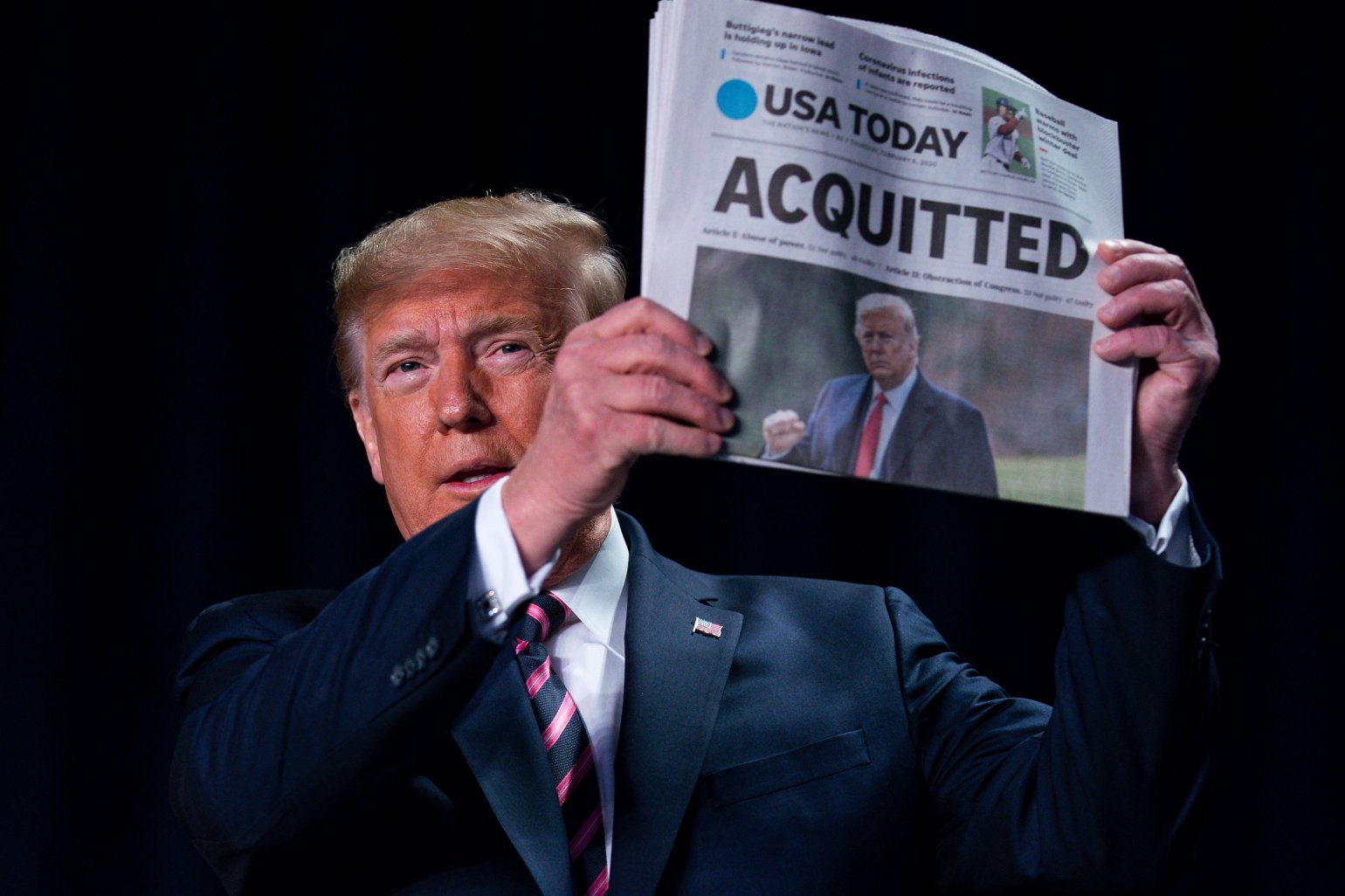
Trump's Acquittal Is Outrageous, But Entirely Precedented

(AP Photo/Evan Vucci via WHOtv.com)
The impeachment saga has ended, with the predictable acquittal of Donald Trump on both articles and equally predictable (though more understandable) shrieks of outrage from liberals who had followed the process every step of the way, engrossed by the whole affair as if it were the latest season in their favorite prestige TV program. At this point, the entire thing looks like it may have been a complete boondoggle, with a recent Gallup poll (one taken before the acquittal vote, even) putting Trump's approval rating at a record high of 49%. Maybe, I'm forced to admit, any impeachment effort—even of the sort I had previously endorsed—was doomed to be counterproductive and end by giving Trump at least the appearance of vindication. In any case, this one certainly doesn't seem to have had the intended effect.

It seems clear that, when it comes to Ukraine (the focus of the impeachment), Trump and his cronies have engaged in activities that are at best unethical, and could have disturbing ramifications if they become normal. It's also clear that these are far from the worst misdeeds that Donald Trump and Co. have engaged in. But for the time being, he's gotten off scot-free for all of it. A certain degree of outrage is not inappropriate.

At the same time, any attempt to portray Trump's acquittal as a scandalous New Low—for the Republican Party, Congress, the political system as a whole or whatever else—is badly misguided. No, the acquittal is far from shocking; rather, if Trump had somehow been convicted, that's what would have been a dramatic break from precedent.

The last president who faced any consequences for his misdeeds was one Richard M. Nixon, whom you might remember as the only American head of state to resign his office before his term was up. Even then, of course, there were limits on just how harsh his punishment would be: his successor, Gerald Ford, helpfully pardoned him for any crimes he may have committed while in office, leaving Nixon to remake himself as some kind of an elder statesmen in the last decades of his life. All he had done, after all, was preside over an extensive campaign to destroy his democratic opposition and then try to cover up the full extent of his henchmen's shenanigans when a few clumsy burglars got caught.

Ever since then, Nixon's famous maxim that "when the president does it, that means that it is not illegal" has held basically true, no matter what "it" happens to be. When Ronald Reagan's administration subverted the will of Congress to funnel money to right-wing terrorists in Latin America, he wasn't even impeached for it. Nor was George W. Bush when his administration lied the country into an illegal and murderous war, set up a massive international torture regime, and engaged in warrantless surveillance on a systematic scale. No; Ronald Reagan went on to be remembered as a sort of patron saint of modern conservatism that even many liberals have paid a cautious sort of respect to, and Bush can now be seen hanging out with high-profile liberals like Ellen DeGeneres and former First Lady Michelle Obama.

Between Nixon's resignation and Trump's impeachment, the only very notable attempt to punish a president for his wrongdoings, real or imagined, was the utterly ridiculous impeachment of Bill Clinton for lying under oath about receiving oral sex. Not, we should note, that grave misdeeds were conveniently confined to Republican presidents: Clinton's bombing of Kosovo without Congressional approval was a flagrant violation of both the constitution and the War Powers Resolution, while Obama continued (and expanded) unconstitutional NSA surveillance programs and literally put a hit out on an American citizen without any pretense of due process. Oh, well.

So sure, vent your spleen about Trump's acquittal if, unlike me, you feel something other than a dull sense of relief that we've reached the denouement of the impeachment soap opera and a feeble sort of disgust about both how the entire thing was handled as well as the end result of it all. But don't delude yourself. This is just the latest example of presidents of both parties being able to get away with (both figurative and literal) murder. Any outrage about the acquittal should also extend to the fact that the notions of "separation of powers" and "checks and balances" have increasingly become a quaint antiquity over the past decades. What's exceptional isn't that Trump was acquitted. It's that he was ever even impeached to begin with.

Saturday, January 25, 2020

A Look at the New York Times' 2020 Endorsement

Members of the editorial board of the New York Times (FX via Slate)
After much anticipation, the editorial board for the nation's Paper of Record, the New York Times, has unveiled its endorsement for the 2020 Democratic primary—and for reasons best understood to the board members themselves, they've decided to endorse both Elizabeth Warren and Amy Klobuchar. The endorsement has little to offer in terms of helping voters make a well-reasoned decision, and isn't even particularly interesting in its choice of candidates. But I want to take a look at it because of the extremely revealing window it offers into the minds of the intelligentsia that plays such a major role in shaping policy and public opinion in the United States—in manufacturing consent, to use the term adopted by Noam Chomsky and Edward S. Herman. And, as we shall shortly see, much of what that window reveals should be extremely disturbing.

The endorsement article starts off okay, noting correctly that we are faced with three visions of the country's future: on the one hand there is the nativist vision offered by Donald Trump; among the Democrats,
an essential debate is underway between two visions that may define the future of the party and perhaps the nation. Some in the party view President Trump as an aberration and believe that a return to a more sensible America is possible. Then there are those who believe that President Trump was the product of political and economic systems so rotten that they must be replaced.
It then moves on to noting the commonalities among the Democrats, saying that "[w]here they differ most significantly is not the what but the how, in whether they believe the country’s institutions and norms are up to the challenge of the moment" (their emphasis). That seems like a pretty major difference, but all right. After that, we get this brief commentary on the notion of "electability":
Many Democratic voters are concerned first and foremost about who can beat Mr. Trump. But with a crowded field and with traditional polling in tatters, that calculation calls for a hefty dose of humility about anyone’s ability to foretell what voters want.
I guess that is what you would write right before endorsing Elizabeth Warren, given her lousy performance in head-to-head polls with Donald Trump.

After (again, largely accurately) summarizing the problems the country faces, the article offers this bit of preamble before it finally gets to the Big Reveal:
Both the radical and the realist models warrant serious consideration. If there were ever a time to be open to new ideas, it is now. If there were ever a time to seek stability, now is it.
Already, we're getting some revealing bits of ideology coming through: the "radical" model is contrasted with the "realist," as if these two things are inherently antonymic: you can't be both realistic and a radical (whatever that means) at the same time. Even more revealing is the idea that Elizabeth Warren represents any sort of radicalism (or that Amy Klobuchar represents "realism" for that matter). What proposals exactly make Warren a radical? Her wealth tax? Her healthcare plan (which she's already generously watered down to appease her more conservative critics)? Her proposal to cancel some (but not all) student debt? In any other developed country, none of these would stand out as particularly radical ideas; indeed, with her vehement commitment to markets and capitalism, Warren might well be seen as center-right. But for the Times editorial board, any deviation from neoliberal orthodoxy, no matter how cautious, is "radical," and their willingness to even consider this radicalism is because they "are rattled by the weakness of the institutions that we trusted to undergird [our] values." Rightly so.

After announcing the endorsement picks, the article moves on to explain its support for Warren. "[S]ome of the most compelling ideas are not emerging from the center, but from the left wing of the Democratic Party," it explains, though "[w]e worry about ideological rigidity and overreach, and we’d certainly push back on specific policy proposals, like nationalizing health insurance or decriminalizing the border." Yes, of course: while a certain dose of "radicalism" might be permissible, the board could never embrace "overreach" such as the end of the bloated and inefficient for-profit health insurance industry, or the reduction of unauthorized border crossings from a criminal to a civil offense. Some things are beyond the pale, after all.

The board then addresses why it isn't endorsing Bernie Sanders. After making sure to mention that he has been "adjacent to the Democratic Party but not a part of it" and briefly touching on his health, the article discusses Sanders' approach to politics:
He boasts that compromise is anathema to him. Only his prescriptions can be the right ones, even though most are overly rigid, untested and divisive. He promises that once in office, a groundswell of support will emerge to push through his agenda. Three years into the Trump administration, we see little advantage to exchanging one over-promising, divisive figure in Washington for another.
Here is the ideology of the New York Times and the intelligentsia it represents in a nutshell. Bernie Sanders is bad because he believes too firmly in the things he says he believes in, and thinks that diluting one's ideas is undesirable (we should note that Sanders supported, for example, the Affordable Care Act, which was a compromise measure to modestly improve the American healthcare system, and has reliably endorsed Democratic presidential nominees well to his right—so it might not be quite correct to say compromise is "anathema" to him). Even worse, those ideas are "rigid, untested and divisive." Yes, ideas like Medicare for All, free college and high taxes on the rich are "divisive" (despite finding strong majority support in polls, depending, in the case of Medicare for All, how the issue is presented), "untested" (despite being similar or identical to existing programs in other economically developed countries) and "rigid" (whatever that means). They are these things, empirical evidence be damned, because they are offensive to the members of the New York Times editorial board.

To cap it off, we then have the grouping of Sanders together with Donald Trump as just another "over-promising, divisive figure[.]" Yes: because both he and Trump are "divisive" (even though Sanders is more popular, and polls better against Trump, than Warren does), they are the same; it doesn't matter that Trump's "divisiveness" is directed at immigrants and religious minorities while Sanders' is directed at the rich and powerful, or that Trump's "divisiveness" takes the form of deportation, ripping children from the arms of their parents and violations of basic civil rights, while Sanders' takes the form of higher taxes: both forms are morally equivalent and deserve to be condemned in the same breath. And Sanders' promise to help build a popular movement of regular people that can take on the privileged elite is just as ludicrous as Trump's promises to build a wall at the southern border and deport 11 million undocumented immigrants. This is the worldview of the insufferable, morally bankrupt, sheltered nerds who sit on the editorial board of the Paper of Record.

It is, indeed, "[g]ood news" for them "that Elizabeth Warren has emerged as a standard-bearer for the Democratic left"—or it would be, if it were true. Currently, she's polling well behind Sanders nationally and in third or fourth place in Iowa, which, it seems, might somewhat damage any claim to be the "standard-bearer for the Democratic left."

The board proceeds to laud Warren as a "gifted storyteller" (if only the stories she told, such as the one about being a Native American, were true, one might add) and claims that "[s]he speaks fluently about foreign policy[.]" An odd claim, given that she was recently humiliated on air by noted idiot Meghan McCain when the latter grilled Warren over her response to the Soleimani assassination. Indeed, it's difficult to think of any impressive moment or accomplishment Warren has had when it comes to foreign policy. Contrast that with Sanders, who helped pass through Congress a resolution that would have ended US support for Saudi Arabia's near-genocidal war in Yemen. Of course, the New York Times is home to Thomas Friedman, who has at times acted practically as a PR representative for the Saudi monarchy, so it's unsurprising the editorial board would not be keen on this sort of foreign policy experience. Instead, they are delighted that Warren speaks about "how to improve NATO relations, something that will be badly needed after Mr. Trump leaves office." Left unanswered is the question of why NATO—a Cold War-era alliance whose stated goal was to deter Soviet aggression—continues to exist decades after the fall of the USSR, especially given its obvious role in increasing dangerous tensions with a nuclear power (Russia). This sort of triviality is not worth the board's time, obviously.

After praising Warren's widely lauded "she has a plan" approach, the board notes:
Carrying out a progressive agenda through new laws will also be very hard for any Democratic president. In that light, voters could consider what a Democratic president might accomplish without new legislation and, in particular, they could focus on the presidency’s wide-ranging powers to shape American society through the creation and enforcement of regulations.
Because the idea of forming a mass popular movement that challenges the normal modes of politics is (to the Times editorial board) just an empty promise, as we have seen, they are left with the most technocratic aspect of the presidency as the way to make important changes. And despite (or, more accurately, because of) Warren's record of capitulating to the forces that oppose a left-wing agenda, and her already-stated plans to appoint business-friendly centrists to her administration, it is she who is qualified to exercise this power, rather than Bernie Sanders.

The board qualifies its endorsement by noting that Warren "has shown some questionable political instincts." No denying that. Those "questionable...instincts" though are not her decision to campaign as a centrist after facing criticism from her right (a decision that coincided with a major dip in her poll numbers), they are that she "sometimes sounds like a candidate who sees a universe of us-versus-thems [sic], who, in the general election, would be going up against a president who has already divided America into his own version of them and us." Again, we get the moral equivalence seen before: promoting division based on race, religion, nationality, etc., as Trump does, is the same as accurately recognizing the defining division in the United States (and the world): that between the exploited and powerless on the one hand and the wealthy, powerful elite on the other.

The article offers us a specific example of what it means: "This has been most obvious in her case for 'Medicare for all,' where she has already had to soften her message, as voters have expressed their lack of support for her plan." This statement is objectively false. Polling released in November of last year found overwhelming support among Democrats for a single-payer plan. It was not "voters," but Warren's opponents and critics in the media who scared her into effective abandoning Medicare for All. To answer the question of what the voters wanted, one can simply look at the polls: over the past few months, as Warren has become increasingly centrist in her rhetoric, her numbers in national polls have declined. At the same time, Bernie Sanders, who unequivocally supports Medicare for All, has seen his standing improve. But the members of the editorial board are not ones to let facts get in the way of a good narrative.

Not shockingly, the board also feels obligated to defend the private health insurance industry, arguing that "[t]hat system, through existing public-private programs like Medicare Advantage, has shown it is not nearly as flawed as [Warren] insists, and it is even lauded by health economists who now advocate a single-payer system." Left out is the fact that administrative costs for Medicare Advantage are "considerably higher," and that "beneficiaries continue to rate traditional Medicare more favorably than Medicare Advantage plans in terms of quality and access, such as overall care and plan rating," in the words of the Kaiser Family Foundation. Surely just an oversight.

Continuing on the same theme:
American capitalism is responsible for its share of sins. But Ms. Warren often casts the net far too wide, placing the blame for a host of maladies from climate change to gun violence at the feet of the business community when the onus is on society as a whole. The country needs a more unifying path. 
Of course: what's needed at a time of record economic inequality isn't to threaten the "business community" but rather to put the "onus" on "society as a whole" and to put the country on a "unifying path." It's no secret whose interests we would be unifying behind, of course.

While "Ms. Warren’s path to the nomination is challenging," the board says, it is "not hard to envision. The four front-runners are bunched together both in national polls and surveys in states holding the first votes, so small shifts in voter sentiment can have an outsize influence this early in the campaign." This claim is particularly odd. In national polls, per RealClearPolitics' average*, Joe Biden is in the lead with 28.4% of the vote while Pete Buttigieg is in fourth (nearly tied with Michael Bloomberg in fifth) at 7.2%. Even if we ignore Buttigieg (who isn't the focus of the New York Times article in any case), Warren has less than 75% of the support Sanders does and barely more than half the support Biden has. While the board is not wrong in its claim that Warren could be the nominee (as I've noted, a possibility that is real and extremely dangerous), it fails to even accurately reflect the existing polling data in this claim—a mistake that, while minor, reflects the concern for factual accuracy consistently displayed in this article.

Moving on to the Klobuchar section of the endorsement, the board begins by laughably singing the praises of "the talents who did throw their hat into the ring and never got more than a passing glance from voters" such as Steve Bullock and Michael Bennet (those two are actually among the examples they cite) and admitting that "[t]hose [moderate] candidates who remain all have a mix of strengths and weaknesses." Not surprisingly, the members of the board "look forward" to Pete Buttigieg's "bright political future" and make sure to note that Michael Bloomberg "was endorsed twice by this page" for mayor of New York City and "would be an effective contrast to the president in a campaign[,]" before offering some criticism of the latter for "his belated and convenient apology for stop-and-frisk policing" and the fact that he "has spent at least $217 million to date to circumvent the hard, uncomfortable work of actual campaigning." To its credit, the board does at least correctly note that Biden's "agenda tinkers at the edges of issues like health care and climate, and he emphasizes returning the country to where things were before the Trump era. But merely restoring the status quo will not get America where it needs to go as a society." Mildly insightful comments such as these are like oases in the intellectual desert that is this article.

But thankfully there is good news: "Amy Klobuchar has emerged as a standard-bearer for the Democratic center." Given her current standing in the polls (around three percent nationally), the word "standard-bearer" is being used here even more loosely than it was the first time around. "Her vision goes beyond the incremental," the board crows. "Given the polarization in Washington and beyond, the best chance to enact many progressive plans could be under a Klobuchar administration." This is genuinely delusional thinking. The Republican Party spent eight years demonizing Obama as a socialist and obstructing his agenda as he bent over backwards to compromise with them. The idea that this wouldn't happen to Klobuchar is ludicrous, and the fact that her stated plans are more modest than Warren's or Sanders' only means they would be watered down all the more before they got through Congress (if they ever did). But the board is convinced that "[h]er lengthy tenure in the Senate and bipartisan credentials would make her a deal maker (a real one) and uniter for the wings of the party—and perhaps the nation."

After summarizing Klobuchar's supposedly impressive domestic agenda (a public option, but no single-payer plan; free community college for all, but not free four-year college), and praising her ability to speak with an "empathy that connects to voters’ lived experiences, especially in the middle of the country" (why is she polling in the low single digits, then?) we get further illustration of what the New York Times editorial board values in foreign policy: that Klobuchar "promises a foreign policy based on leading by example, instead of by threat-via-tweet" and "has sponsored and voted on dozens of national defense measures, including military action in Libya and Syria." It's unsurprising but still disgusting that supporting the military intervention in Libya (which helped reduce the country to a failed state with a flourishing slave trade) and proposing to intervene further in Syria (where the US has already helpfully supplied "moderate" rebels with weapons that fell into the hands of ISIS) is a plus in the minds of the imperialists running the national "newspaper of record."

Klobuchar, the board gushes is "the most productive senator among the Democratic field in terms of bills passed with bipartisan support, according to a recent study for the Center for Effective Lawmaking." We might think that the content of those bills would be relevant, but never mind that. Reading on, we are told:
When she arrived in the Senate in 2007, Ms. Klobuchar was part of a bipartisan group of lawmakers that proposed comprehensive immigration reform, including a path to citizenship for 12 million undocumented immigrants, before conservative pundits made it political poison.
Conservative pundits would simply observe a respectful silence if Klobuchar were elected president, we can assume, allowing her to pass her agenda with no trouble. We also learn of Klobuchar's "background as the chief prosecutor in Minnesota’s most populous county"—just who the country needs as president, at a time when the US is already a world leader in incarceration rates.

The editorial makes sure to briefly address the elephant in the room, noting that "Reports of how Senator Klobuchar treats her staff give us pause. They raise serious questions about her ability to attract and hire talented people." But we are reassured that "Ms. Klobuchar has acknowledged she’s a tough boss and pledged to do better." Besides, "Bill Clinton and Mr. Trump—not to mention former Vice President Biden—also have reputations for sometimes berating their staffs, and it is rarely mentioned as a political liability." The Times editorial board knows very well that this is an inadequate and misleading description of the allegations against Klobuchar. Their own paper previously reported that Klobuchar "was known to throw office objects in frustration, including binders and phones, in the direction of aides," according the former aides interviewed, and that "Low-level employees were asked to perform duties they described as demeaning, like washing her dishes or other cleaning—a possible violation of Senate ethics rules, according to veterans of the chamber." While Klobuchar's behavior toward her staff is hardly the most major issue in this election, the board's unwillingness to honestly address it after bringing it up themselves is yet another illustration of their character, or lack thereof.

After mentioning Klobuchar's popularity in Minnesota (a state carried by every Democratic presidential nominee since Jimmy Carter), the article informs us that "it’s far too early to count Ms. Klobuchar out—Senator John Kerry, the eventual Democratic nominee in 2004, was also polling in the single digits at this point in the race." We've practically reached the point of self-parody with this claim. Amy Klobuchar is, again, polling at about three percent nationally and has less support among black voters than even Pete Buttigieg. In Iowa, where John Kerry won the 2004 Democratic caucuses, she's polling in a distant fifth place. Klobuchar's odds of being the Democratic nominee are roughly the same as mine, and if the New York Times editorial board believes otherwise it's only through an extreme act of self-delusion.

To conclude, the board summarizes several major world problems (wildfire in Australia, instability in the Middle East, a "historic flood of migrants" at the southern border) which both of its endorsed candidates are ill-equipped to deal with, before urging the removal of President Trump and addressing how the aftermath of his presidency can be dealt with:
Any hope of restoring unity in the country will require modesty, a willingness to compromise and the support of the many demographics that make up the Democratic coalition—young and old, in red states and blue, black and brown and white. For Senator Klobuchar, that’s acknowledging the depth of the nation’s dysfunction. For Senator Warren, it’s understanding that the country is more diverse than her base.
Once again, we get a paean to "unity"—not justice, not equality, not democracy, but only a vague notion of "unity." The idea that the divisions in the United States might stem from structural inequities that require more than token reform efforts to rectify is left unaddressed. Also unmentioned is the reality that eight years of Barack Obama—whom it seems likely the board would agree possessed "modesty, a willingness to compromise and the support of the many demographics that make up the Democratic coalition"— left the country more divided than it was before he took office. Some might foolishly think that is because the "divisions" in the United States need to be addressed with more than kind words and attempts to compromise with the opponents of social and economic equality, but the members of the editorial board are not among those ignorant peons.

While recognizing that "There will be those dissatisfied that this page is not throwing its weight behind a single candidate, favoring centrists or progressives," the board magnanimously writes that that fight "should be played out in the public arena and in the privacy of the voting booth." Of course, given that the board has passed over and openly disparaged the only candidate who actually represents a fundamental break with the political status quo, it's quite clear which side they're actually on. Unable to disguise their neoliberal approach to politics, the board continues: "That’s the very purpose of primaries, to test-market strategies and ideas that can galvanize and inspire the country." Some would say that the purpose of primaries is for an electorate to choose their party's candidate, and the direction the party should go in; but the editorial wisely reduces voters to the level of passive consumers to be used as a test audience by the candidates as they search for a successful way to brand themselves. The article then closes out on a feminist note that's as vacuous as anything else in it, concluding: "May the best woman win."

While, as previously noted, the New York Times editorial board's endorsement article is more or less useless for voters interested in giving future generations a decent existence, it is highly informative in other ways. The fact that the board opted to endorse one candidate who is much more likely to split the progressive vote and give Biden the nomination if she stays in the race than she is to be the nominee, and another candidate with no realistic shot of winning the race, speaks volumes about where their heads are at. Plainly, they cannot reconcile themselves to Bernie Sanders (no surprise), but they recognize that Joe Biden is too much a relic of a past era to save the Democratic Party from the left-populist insurgency Sanders represents. While the editorial board may very well be secretly hoping he manages to secure the nomination over Sanders, openly throwing their weight behind Biden would be a transparent admission that their primary objective is to protect the status quo from any radical disruptions. Only endorsing Klobuchar would, for obvious reasons, border on farce. Best, then, to also support the faux-progressive who might engage in "divisive" rhetoric occasionally, but would pose little threat even if she were elected.

The one encouraging aspect of the whole affair is how it reeks of desperation on the editorial board's part; the intelligentsia are getting nervous. They should be. If we are lucky, we may be witnessing the beginning of the end of their relevance.

______________________________________________________


*The averages I cite here and elsewhere in this post have shifted slightly since I started writing this blog post, but I'm using the older ones since they're more reflective of the polls that were current when the New York Times published their endorsement. The changes that have happened since, it's worth noting, have not done much to improve Warren or Klobuchar's standing in the race.

Monday, January 20, 2020

Elizabeth Warren is the Most Dangerous Democratic Candidate

Senator Elizabeth Warren at the fourth Democratic debate (John Minchillo/AP via The Philadelphia Inquirer)

Despite my very real issues with Warren, I really don't want this to come off as a hit piece of any sort. She is still easily better than almost all of her opponents, and vastly better than the guy who's currently at the top of every national poll. She has also put out some genuinely laudable proposals lately. Certainly, no one should lose sight of that, nor do I want there to be some split in the more progressive wing of the Democratic Party.
The Latest Sedition, June 18, 2019
Well, I was wrong—and for whatever it's worth, you can feel free to consider this a hit piece. While Warren's recent bullshit about Sanders supposedly telling her a woman couldn't get elected president—an allegation that she's cynically left as vague as possible and which makes little sense based on Sanders's history—has turned my disenchantment with Warren into a full-blown disgust, that's not my main motivation for writing this piece. No; my newfound animosity toward her might make this more fun, but my change of heart stems from reason, not passion.

I laid out in detail in my last piece why our only hope lies with a radical disruption of the status quo, and explained that Bernie Sanders is the only candidate who would (hopefully) represent that disruption. But why couldn't Warren? What makes her so different? For one thing, the fact that she's a completely feckless appeaser who's unable to stand by the principles she claims to represent. She's claimed to support Medicare for All, but put forth a plan for getting there that's so patently stupid it's obvious her support isn't sincere. Big structural change? That's a funny joke when you're already talking about filling your administration with corporate lackeys. Whatever laudable work Warren may have done in terms of bankruptcy reform and consumer protection, it's plain at this point that she lacks any serious commitment to challenging the control the ruling class exercises in the United States.

Even her supporters can't make her sound like anything other than a nerdy technocrat. "She understands how to focus and wield the powers of the regulatory state better than anyone else," Ezra Klein gushes. Wow, isn't that inspiring! She knows how to focus and wield the powers of the regulatory state? Sign me up! I'm sure the candidate who wasn't even able to keep up the pretense of being a social democrat until the Iowa caucuses will be really ruthless in how she exercises those fearsome powers. Climate change and inequality are no match for this Bold Progressive!

To summarize: Warren 1. has no interest in moving away from the top-down, technocratic form of politics that's dominated the Democratic Party for decades and 2. is so weak and unprincipled that she couldn't lead (or even do much to encourage) any popular movement if she wanted to. The idea that one principled politician and their team of experts could solve the world's problems while the rest of us sit at home is an utter fantasy. But even if it weren't, that person isn't Elizabeth Warren because she's already proved to be either a coward or a fake who, either way, capitulates at the first sign of trouble. So, as I indicated last time: electing Warren solves nothing and only paves the way for the rise of another right-wing populist like Trump, but potentially smarter and more competent, therefore more dangerous. Again, this isn't wild speculation: just look at how the Democratic Party fared under Obama, and how his hand-picked successor fared against Trump.

But don't worry too much about that: if Warren does get the nomination, there's a good chance she'd just lose to Trump in the general election. Right now, RealClearPolitics' polling average has her ahead nationally by 0.4%; Hillary Clinton won the popular vote by over five times that much, and still lost the electoral college. RCP's average has Trump ahead by one point in Wisconsin, one of the key states that Trump flipped in 2016; in Iowa, his lead is over six points; in Florida, two points. If Trump can carry those states, all the states that Mitt Romney won in 2012, and Ohio (where head-to-head polling is sparse but which he carried by 8% in 2016), he's at 269 electoral votes. If he can also carry Maine's second Congressional district—which he carried by double digits in 2016—that makes 270 votes, which is enough to win the election. That's not even to get into Pennsylvania or Michigan, both of which Trump won in 2016. Warren leads narrowly in those states, though not by as much as Clinton did right before unexpectedly losing both.

All of this is before any general election campaign has even begun, and absolutely nothing about Warren indicates she'd hold up well against Trump. The fact she pretended to be a Native American for a huge portion of her life is an absolute godsend to someone like Trump, who—unlike Warren's fellow Democrats—will not be too polite to repeatedly bring it up. Her utter spinelessness in the face of criticism from her right so far in this campaign bodes poorly for how she would respond to Trump's attacks; and, like most of her fellow Democrats onstage at the last debate, she's announced her support for the proposed trade deal that will undoubtedly be one of the crowning achievements of Trump's first term.

Of course, Warren's not the only Democratic candidate who would make a lousy president (most of them would), or who might lose to Trump (any of them could, though Bernie and Biden certain look likelier to win than Warren does). But her faux-progressive veneer makes both results all the more dangerous. If she does win, we could see the same complacency that affected liberals and left-leaning people during the Obama years start to creep back in; high off defeating Trump and electing the country's first woman president—one promising to bring "Big Structural Change"—many progressive-minded people might be content to sit back and relax. There's no reason to think Warren would do much to discourage that either, given her technocratic mindset. What makes her especially dangerous in this respect is that even many people who want the Democrats to shift leftward think Warren is at least ok (I was one of them not that long ago); at least under a Buttigieg or Biden administration, these people would have no illusion that they'd won, and would have every reason to stay active. By the time Warren betrayed her promise to bring that big structural change (and she would betray it), it would probably be too late to do much about it—just as the left couldn't do much about it when Obama turned out to be a guardian of the status quo, not someone bent on overhauling it.

If Warren lost the general election to Trump, that would also carry unique dangers, again because of her (increasingly undeserved) reputation as a progressive. Given much of the media's undisguised hostility to anything that has even a whiff of leftism, we'd be certain to see a never-ending barrage of commentary on how the Democrats blew the election by nominating someone too radical, and that they could have won if only they'd gone with a safe choice like Joe Biden or Amy Klobuchar. Unfortunately, many well-meaning voters would readily fall for this, given that centrist candidates are already frequently seen as more "electable" than their left-wing opponents. Just as the example of George McGovern's landslide defeat in 1972 is still dredged up almost 50 years later, Warren's loss to Trump would be used for decades to come as an argument against nominating anyone "too extreme." If Biden or Buttigieg lost to Trump, at least no one could say it was because they were too left-wing. (Obviously, if Sanders lost to Trump, we would see the same arguments as if Warren did—but, again, Sanders looks likelier to win than Warren).

It should be clear, then, that Elizabeth Warren is not an acceptable alternative to Bernie Sanders. She is not even a good "second choice" for leftists. She is the most dangerous candidate in the Democratic primary, and her nomination must be prevented. As obscene as it may seem, if the choice comes down to Warren and Biden somehow (if, God forbid, Bernie has further health problems and has to drop out for instance), leftists should support Biden. If he lost, no one could say it was because he was too progressive, and if he won then at least there would be no illusion that we had achieved anything but a return to the Obama years; plus, it seems likely he wouldn't run for reelection, leaving the Democratic primary open in 2024 (if Warren was elected in 2020 she would, presumably, run for reelection in 2024 and easily secure her party's nomination). The likeliest outcome of a Warren nomination at this point appears to be her defeat in the general election, giving us not only four more disastrous years of Donald Trump but also handing the enemies of any sort of leftist agenda a powerful argument against nominating progressive candidates in the future; this is a far worse outcome than a Biden presidency.

But as long as Bernie Sanders is still in the race, the correct approach is to fully support him to the bitter end, particularly in the face of recycled smears that he and his supporters are a bunch of sexists. "Woke" leftist attempts to accommodate these accusations in the name of "recognizing misogyny on one's own side" are entirely the wrong approach when the accusations are motivated by pure cynicism, as well as by the classist notion that the poor and working class who support Sanders are a bunch of ignorant bigots. The only correct response is to recognize these attacks as the reprehensible smears they are, and even to ask why Warren and her supporters feel the need to dishonestly attack the candidate who would be our first Jewish president (perhaps they're all secretly antisemites themselves—no more ridiculous a claim than their own lies about Sanders and "Bernie bros"). And we should have no concern about "progressive unity" or handing Biden the nomination as we fight back; better the nomination go to an outspoken centrist than to one who pretends to be something they're not.

ADDENDUM: While it's moot now, I want to note that this post was written before Tara Reade came out with her full, and deeply disturbing, allegations against Biden; if these allegations had been public at the time I'd written this post, I would not have argued leftists should support Biden over Warren.